
Should You Create a Website Page for Every Suburb You Serve?
Learn when an Australian service business needs suburb pages, what useful location pages should include, and how to evaluate local SEO and AI search visibility.
Learn when an Australian service business needs suburb pages, what useful location pages should include, and how to evaluate local SEO and AI search visibility.
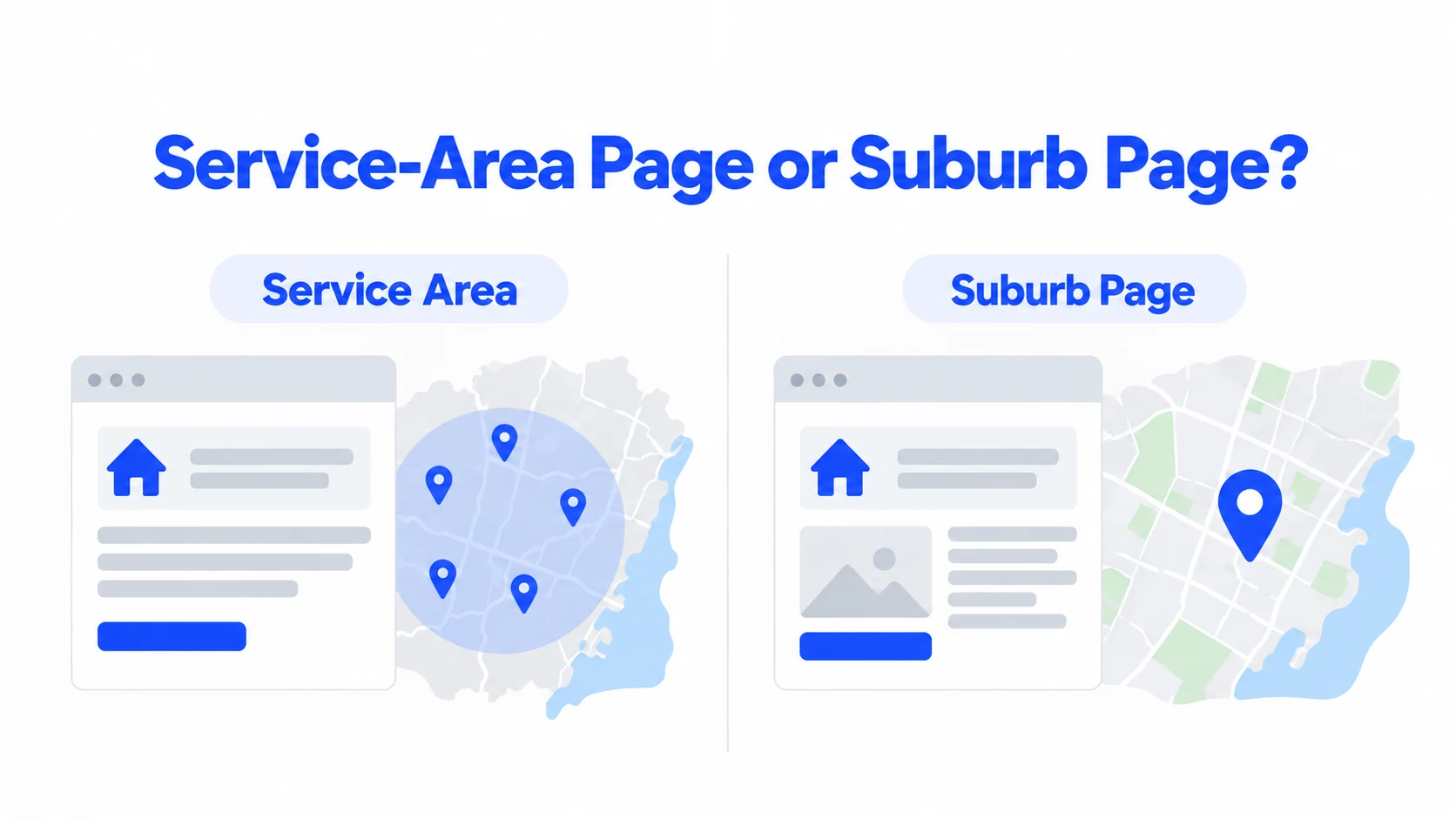
Do you need a page for every suburb your business serves? Usually, no. If you run a cleaning, plumbing, electrical, landscaping or other mobile service business, start with clear service pages and an accurate service-area page. Add individual suburb pages when they give customers useful information they cannot easily get from your existing pages.
For example, a plumber working across Parramatta, Blacktown and Penrith does not automatically need three separate pages. The decision depends on what customers need to know about service availability, pricing, previous work and booking in each area. This guide shows you how to make that decision, build your first page and measure whether it helps generate enquiries.
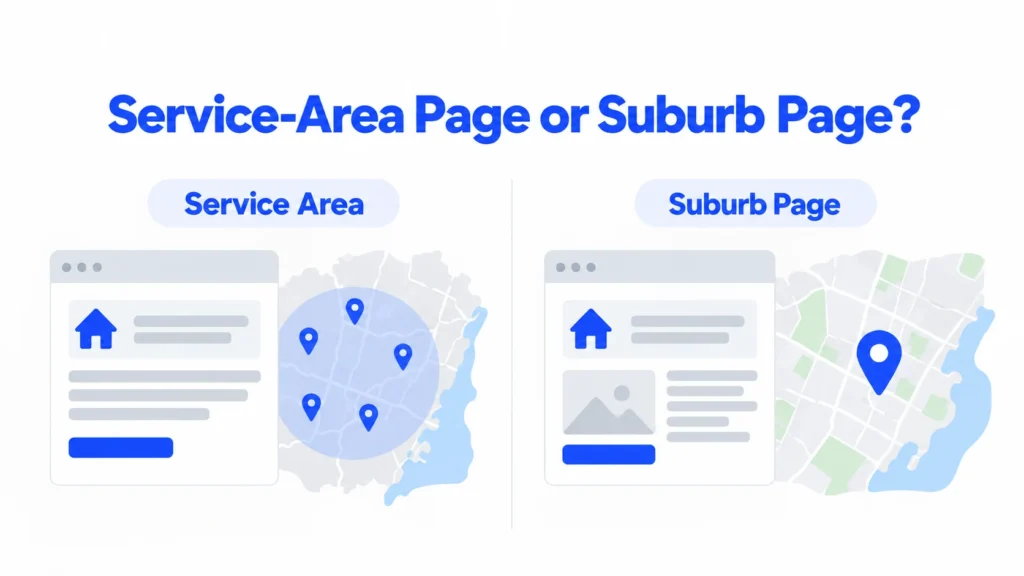
A service-area page explains the geographic areas where a business travels to customers. It might list your covered suburbs, booking conditions, travel charges and links to your main services. A suburb page is a more specific page, such as “End-of-Lease Cleaning in Parramatta”, created to answer questions about your service in that location.
Neither page establishes a physical office. If you operate from one base and travel to customers, describe that arrangement honestly rather than presenting every suburb as a branch. If your company has genuine, separately staffed branches, see our separate guide to AI search for franchises and multi-location businesses.
Use this decision guide before creating a new URL:
| Your situation | Practical starting point | Why |
|---|---|---|
| You offer the same services, prices and booking process across nearby suburbs. | One detailed service-area page. | Customers can check coverage without moving between nearly identical pages. |
| You regularly work in one suburb and have relevant photos, job examples or useful location-specific details. | Consider a dedicated suburb page. | You can answer questions and demonstrate genuine experience in that location. |
| Availability, travel charges or services genuinely differ by area. | Explain those differences on the relevant page. | Customers can make a more informed booking decision. |
| You have no meaningful information beyond swapping the suburb name in a template. | Improve your existing service-area page first. | Another URL would add little value. |
A simple test: if you removed the suburb name from a proposed page, would there still be useful information that makes it different? If not, you may not need that page yet.
Imagine a fictional Sydney cleaning business that already completes end-of-lease jobs in Parramatta. The following is an illustrative content brief, not a claim about an actual Webbotica client.
Opening: “Moving out of a Parramatta apartment or house? We provide end-of-lease cleaning in Parramatta and nearby areas. Tell us your property size, move-out date and cleaning requirements to request a quote.” Use wording like this only if the business genuinely provides the service.
The page can use the same design as other suburb pages. The important difference is the information: do not pad a page with invented local jobs, made-up testimonials or claims that you have a local office.
Keep detailed descriptions of your core services on their own pages, then link to them wherever relevant. A simple website structure for a single-base cleaner could look like this:
These URLs are examples; you do not need to copy the exact structure. Link your suburb page to the relevant main service page and let people navigate back to the service-area overview. Give each page a descriptive title and heading, and keep key information visible as text on mobile as well as desktop. For help with the fundamentals, see Webbotica’s website design and development service.
Creating a page for a genuine service area is not inherently a problem. The risk comes from making numerous substantially similar location pages that exist mainly to capture searches and send everyone to a more useful final page. Google’s Search spam policies describe this as a possible form of doorway abuse.
For instance, replacing “Parramatta” with “Blacktown” in 30 otherwise identical pages is not a substitute for useful location information. Shared business information is normal, but each dedicated page should have a reason to exist for its visitor.
Also distinguish a mobile service area from a physical branch. If you don’t serve customers at your business address, Google’s Business Profile guidelines generally require service-area businesses to hide that address. Don’t manufacture storefront addresses or extra business profiles to appear in more suburbs.
They can make your services and coverage more clearly available to customers and search systems, but there is no special suburb-page requirement for ChatGPT or Google AI search, and no guaranteed recommendation.
Consider a customer asking: “Find a plumber who repairs hot-water systems and services Penrith.” Your website should plainly state whether you offer that service in Penrith, how someone can contact you, and any genuine restrictions. A clear main service page plus an accurate service-area page may answer this perfectly well. A dedicated Penrith page is useful when it adds meaningful local information, not because AI systems demand another URL.
Google says established SEO practices remain relevant to its AI features. It recommends original and helpful content, accessible textual information and sound technical structure; it does not require special AI-specific schema or files. Read Google’s guidance for generative AI features. OpenAI’s crawler documentation explains that permitting its OAI-SearchBot can help make public pages available for ChatGPT search results. Neither platform promises inclusion.
Start with accurate service descriptions, readable location details, functioning internal links and a usable contact route. For a wider explanation, see what a service-business website should say for AI search. If you want to check what actually happens in AI responses, our AI search visibility measurement guide explains how to record observations without mistaking one answer for a stable ranking.
No. Your website pages and the service areas in your Google Business Profile are different settings. Google allows eligible service-area and hybrid businesses to specify up to 20 service areas based on cities, postcodes or other supported areas. Google also says the overall service-area boundary generally shouldn’t extend beyond about two hours’ driving time from the base, although some exceptions may be appropriate. See Google’s service-area guidance.
That 20-area limit is not a recommendation to build 20 website pages. Use your profile to represent your real service coverage, and choose your website structure based on what your customers need to know. For further reading, see our guide to Google Business Profile and AI search.
What to track: page URL, target suburb, publication date, relevant search queries, organic landing-page visits, genuine enquiries and the next change to test. This is a practical performance record, not an invented “AI ranking score”.
There isn’t a universal number. Start with clear main service and service-area pages. Add an individual suburb page only when it offers useful information for people in that location. One accurate page can be more useful than numerous near-duplicates.
Yes, you can explain that you travel to customers there if that is true. Don’t imply that your mobile business has an office or storefront in the suburb when it doesn’t.
Not automatically. Five services across ten suburbs do not inherently justify 50 pages. Keep comprehensive main service pages and create more specific pages when a particular service-location combination has distinct, useful information.
No. A helpful, accessible page can explain your services and location clearly, but search and AI systems make their own decisions about what they display. Evaluate customer usefulness and measured enquiries rather than promising placement.
A customer looking for a cleaner, plumber or electrician wants to know three things: Can you do the job? Do you serve my area? How can I contact you? Your website should answer those questions without making them navigate dozens of lookalike pages.
Start with accurate services and coverage. Create dedicated suburb pages when they add genuine value, keep them connected to the rest of your website, and review whether they generate useful enquiries.
Need help planning your website’s service-area structure? Webbotica builds websites and improves local visibility for Australian service businesses. Explore our SEO services or contact Webbotica to discuss a website that helps customers find and choose your business.
READY FOR THE NEXT STEP?
If you want help improving how your business is found, trusted and contacted online, we can work out the right next step with you.
Start a ConversationA local service business does not need to rank #1 on Google to appear in ChatGPT. Here’s what OpenAI confirms, what SEO…
Read guide
Can customers find your business when they search using ChatGPT, Google AI or Microsoft Copilot? If your website clearly explains your services,…
Read guide
A practical guide for franchises and multi-location service businesses: build accurate branch pages, avoid fake location listings, and check AI search visibility…
Read guide