What should a service business website say so AI search can understand it?
Clear guidance for service businesses on what website content helps customers and AI search understand services, locations, proof and next steps.
Clear guidance for service businesses on what website content helps customers and AI search understand services, locations, proof and next steps.
A service-business website does not need to “write for AI”. It needs to make the business unusually easy to understand.
That means stating, in visible and specific language, who the business is, what it actually does, where it works, who each service is for, what customers should expect, and what evidence supports important claims.
Current guidance from OpenAI, Google and Microsoft does not establish a special copywriting formula that guarantees inclusion in AI-generated answers. OpenAI says any public website can appear in ChatGPT search, while Google says the same foundational SEO practices used for normal Search remain relevant to AI Overviews and AI Mode, with no additional technical requirements or special optimisations required.
So the practical goal is not to make a website “sound like AI”. It is to remove ambiguity.
For a customer, understanding a local business means being able to answer basic questions quickly:
Those same facts are useful to search and retrieval systems because they give a page a clear subject, context and purpose.
Microsoft’s current AI Performance guidance recommends aligning content with user intent, improving clarity and structure, supporting claims with evidence, and keeping information accurate and current. Google’s current generative-AI guidance similarly emphasises valuable, unique, non-commodity content rather than repackaged material that could be produced anywhere.
None of that means an AI model “reads” a website exactly like a person. Different systems crawl, index, retrieve and generate answers differently. But the direction is useful: if the page itself is vague, systems have less reliable information to work with.
Many service-business websites are surprisingly unclear about the service itself.
A homepage might say:
Quality solutions you can trust.
That sounds positive, but it tells a customer almost nothing. It also gives a retrieval system very little concrete information about what the business should be associated with.
A stronger version would be closer to:
Residential electrician providing switchboard upgrades, fault finding, lighting installation and emergency electrical repairs across Western Sydney.
The second version is not better because it contains more keywords. It is better because it communicates more facts.
The page establishes the business type, several actual services, the customer context and the service area. A person can decide whether the business is relevant without guessing.
For a local service business, location is part of the offer.
If you service Parramatta, Blacktown, Liverpool and nearby areas, make that information visible where it is genuinely relevant. Do not assume a footer address alone explains where the business works.
A useful service page might say:
We provide mobile car detailing across Liverpool, Casula, Prestons and surrounding south-west Sydney suburbs.
That is more useful than a vague statement such as “servicing Sydney”.
At the same time, avoid creating dozens of near-identical suburb pages that simply swap place names. If the business genuinely has different information, availability, travel conditions, projects or service details for a location, a dedicated page can make sense. If not, one strong service-area section may be more useful than a collection of thin pages. The same principle applies to keeping your Google Business Profile accurate for AI search and local discovery.
OpenAI’s ChatGPT Search guidance confirms that location information can be relevant to local results. The takeaway is simple: do not make customers or search systems infer where you operate.
A strong service page does more than name the service. It helps the customer decide whether the service fits their situation.
For example, a cleaning company offering an end-of-lease clean could explain:
This makes the page useful for a wider range of real questions than a page that says only “professional end-of-lease cleaning at competitive prices”.
Service businesses often know their process so well that they forget the customer does not.
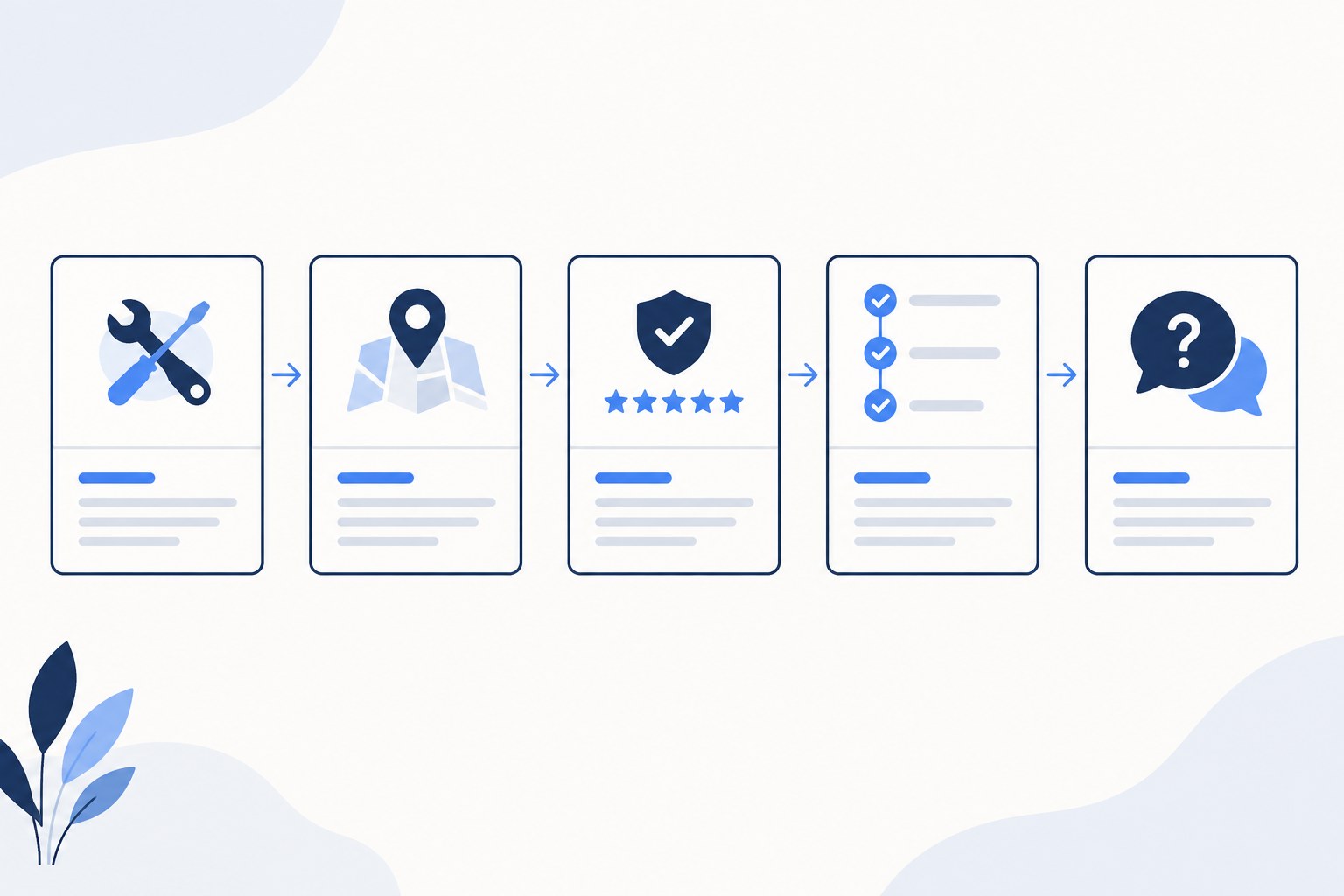
A clear process can make a page easier to understand and more useful:
The exact process will differ by industry. A plumber, dentist, cleaner and solicitor should not force themselves into the same five-step template. The principle is simply to make the real customer journey visible.
Statements such as “trusted”, “experienced”, “premium” and “leading” are common because they are easy to write. They are weak when the page gives the reader no reason to believe them.
Where appropriate, replace broad claims with verifiable facts:
For educational claims — especially health, legal, financial, safety or technical claims — link to authoritative sources where that improves the page.
Microsoft’s AI guidance recommends supporting claims with evidence. Google’s people-first content guidance also asks whether a page presents information in a way that makes the reader want to trust it and whether the content contains easily verifiable factual errors.
This does not prove that adding a licence number or case study will make ChatGPT cite the page. It simply creates stronger, more verifiable information than unsupported marketing language.
The best service-business content is often hiding inside normal customer conversations.
Think about the questions people repeatedly ask by phone, email, WhatsApp or in person:
Those questions are strong candidates for service-page sections, FAQs or genuinely useful supporting articles.
Do not add an FAQ merely because someone says “AI likes FAQs”. There is no public OpenAI rule establishing an FAQ block as a direct ranking factor for ChatGPT Search. Add one when it helps a customer get an important answer quickly.
The homepage should give a clear summary of the business rather than trying to contain every detail.
A useful homepage usually makes these points easy to find:
A useful test is to show only the homepage hero and first section to someone unfamiliar with the business. If they cannot tell what the business does and where it operates, the copy is probably too abstract.
A service page should be specific enough to answer the customer’s real decision.
This is not a mandatory SEO template. Some services need fewer sections; complex or high-consideration services may need more. The point is to make the page complete enough that a reader can understand the offer and make a decision.
No. Clarity is useful. Repetition for its own sake is not.
Writing “Sydney plumber” in every paragraph does not make a page more understandable. It usually makes the page worse to read.
Google’s Search Essentials recommends using the words people would use to look for content in prominent, descriptive locations such as the page title, main heading, alt text and link text. That is different from stuffing the same phrase throughout the copy.
There is no documented universal AI copy format.
Google says there are no additional technical requirements or special optimisations needed to appear in AI Overviews or AI Mode beyond the normal requirements and best practices for Search. OpenAI’s publisher guidance focuses on making public content accessible to OAI-SearchBot so it can be discovered, surfaced, cited and linked.
That means tactics such as these should be treated cautiously unless a platform documents them:
Before publishing or rewriting a major service page, ask:
If several answers are “no”, the page probably has a clarity problem before it has an “AI optimisation” problem.
If you cannot rewrite everything at once, prioritise in this order:
That order matters because a perfectly structured FAQ cannot compensate for a service page that never clearly explains the offer.
There are important limits to what can be claimed.
OpenAI does not publish a complete ChatGPT Search ranking formula. Google does not publish a simple checklist that guarantees a page will be selected as a supporting link in an AI Overview or AI Mode response. Microsoft’s AI Performance data shows citation activity, but Microsoft explicitly says those citation counts do not measure ranking, authority, importance or a page’s role inside an answer.
Different systems also use different models, indexes, partners and retrieval methods.
So no one can responsibly promise that a particular sentence structure, service-page template or number of FAQs will make a local business appear in AI answers.
If you want your website to be easier for search and AI systems to interpret, start with the same question a potential customer has:
Can I quickly work out who this business is, what it does, whether it can help me, where it works, and why I should believe what the page says?
Make those facts explicit. Build genuinely useful service pages. Answer real pre-enquiry questions. Keep the business information accurate. Support meaningful claims with evidence. Make important pages crawlable.
Then treat AI visibility as an additional outcome to measure — not as a reason to replace good communication with “AI-friendly” copy. For more context, read our practical guide to ChatGPT and AI search.
The website should be written so customers can understand and trust the business first. That same clarity gives search and retrieval systems better information to work with.
READY FOR THE NEXT STEP?
If you want help improving how your business is found, trusted and contacted online, we can work out the right next step with you.
Start a ConversationA local service business does not need to rank #1 on Google to appear in ChatGPT. Here’s what OpenAI confirms, what SEO…
Read guide
Can customers find your business when they search using ChatGPT, Google AI or Microsoft Copilot? If your website clearly explains your services,…
Read guide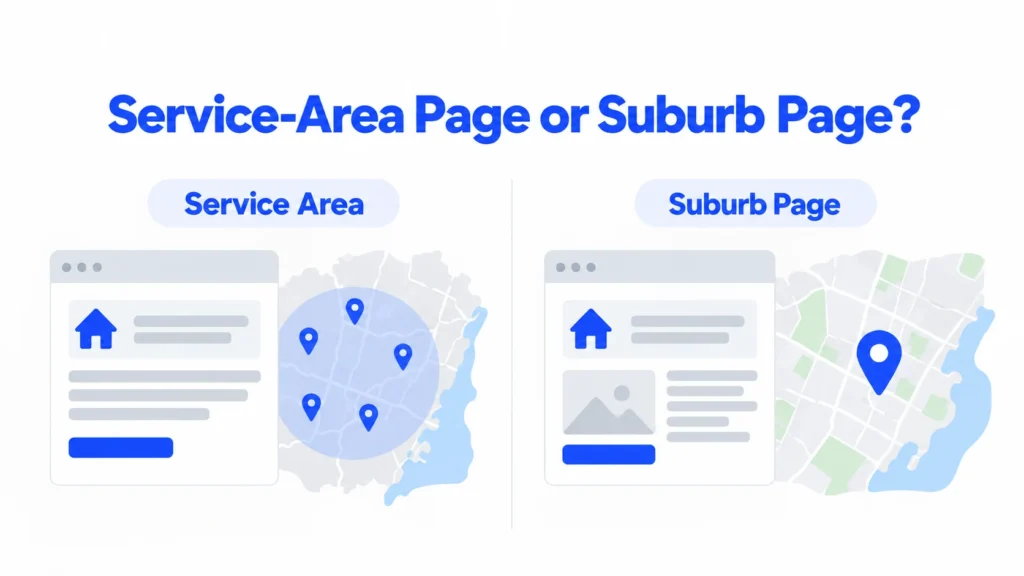
Learn when an Australian service business needs suburb pages, what useful location pages should include, and how to evaluate local SEO and…
Read guide