Does schema markup help a local business appear in AI search?
Schema markup can help search engines understand a local business website, but current primary evidence does not establish it as a direct AI search ranking factor.
Schema markup can help search engines understand a local business website, but current primary evidence does not establish it as a direct AI search ranking factor.

Schema markup can help search engines understand specific information on a local business website, but there is no good evidence that adding schema gives a business a direct ranking boost in AI search. Google explicitly says structured data is not required for its generative AI search features and that there is no special schema.org markup you need for AI Overviews or AI Mode. OpenAI’s current guidance for appearing in ChatGPT Search does not identify schema as a direct ranking factor either.
That does not make schema useless. It means local businesses should use it for what it is actually good at: describing real information clearly, supporting documented search features where eligible, and making important facts easier for machines to interpret without changing what the visible page actually says.
Schema markup is a form of structured data: machine-readable information added to a webpage to describe what certain content means.
For example, a local business page may contain a business name, telephone number, address, opening hours and website URL. A person can usually infer what those details represent from the page design. Structured data can label those facts explicitly.
Google describes structured data as a standardised format for providing information about a page and classifying its content. Google also says it uses structured data to understand page content and to make some pages eligible for enhanced search appearances known as rich results.
That is a documented benefit. It is different from saying schema makes an AI assistant trust or recommend the business.
Google’s current guidance is unusually clear on this point.
For AI Overviews and AI Mode, Google says the same foundational SEO practices used for normal Search remain relevant. Its recommendations include making important information available as text, allowing crawling, using useful internal links, maintaining good page experience and ensuring structured data matches the visible content on the page.
But Google also says there are no additional technical requirements for appearing in these AI features. It specifically states that websites do not need new machine-readable files, AI text files or special schema.org structured data.
Google’s separate 2026 guidance on optimising for generative AI search goes further: it warns site owners against overfocusing on structured data. Google says structured data is not required for generative AI search, although it remains worthwhile as part of a normal SEO strategy because it can support eligibility for rich results.
So the evidence supports a fairly simple conclusion:
Use schema because it can accurately describe your content and support established search features. Do not add it because somebody promised it is a secret AI Overview ranking factor.
There is even less basis for claiming a direct schema advantage in ChatGPT.
OpenAI says public websites can appear in ChatGPT Search. Its current publisher guidance tells website owners who want their content discovered and cited to make sure they are not blocking OAI-SearchBot.
OpenAI’s guidance does not currently identify Schema.org markup, LocalBusiness schema, FAQ schema or a special “ChatGPT schema” as a direct ranking requirement.
That does not prove ChatGPT never processes structured information found on webpages or through its broader search ecosystem. It means we do not have primary evidence for the stronger marketing claim that adding schema will make ChatGPT rank or recommend a local business.
Those are very different statements, and the distinction matters.
Because AI search still depends on information that exists across the wider web and on search systems that can discover, interpret and retrieve that information.
Google’s AI search experiences still rely on pages that meet normal Search requirements. Microsoft is now giving site owners visibility into pages cited across Bing and Copilot through its AI Performance reporting. OpenAI’s search product also depends on discovering relevant public web content.
Good technical SEO therefore remains useful even when the final customer experience is an AI-generated answer rather than a list of blue links. For the broader foundations beyond schema, see Webbotica’s guide to ranking in ChatGPT and AI search.
Schema can contribute to that technical foundation in several practical ways.
Appropriate structured data can describe information such as the organisation behind a website or, where relevant, a local business’s address, telephone number and opening hours.
This is useful when the markup accurately reflects what the customer can also see on the page. It gives search systems an explicit representation of facts rather than asking them to infer every relationship from layout and prose.
It is reasonable to see that as reducing ambiguity. It is not reasonable to turn that into an undocumented claim that “less ambiguity equals higher ChatGPT rankings”.
Google supports structured data for particular search features, including articles, breadcrumbs, local businesses, products, events and other content types.
Correct implementation can make a page eligible for the relevant enhanced search appearance. Eligibility is the important word: Google explicitly says correctly marked-up content is not guaranteed to receive a rich result.
For a local service business, this conventional search benefit is enough reason to implement useful schema properly. You do not need an AI-specific story to justify it.
Implementing schema well requires decisions about what a page represents and which facts are actually true.
That can expose problems such as inconsistent business names, outdated contact information or markup that describes services the visible page barely mentions. Fixing those inconsistencies improves the information itself, not merely the code surrounding it.
There is no universal checklist that every local business should install. The markup should reflect the real content and purpose of the page.
Depending on the website, useful structured data may include:
The objective is not to accumulate the highest possible number of schema types. It is to describe the page accurately.
Do not treat FAQ schema as an AI-search hack.
A useful FAQ section can still be valuable because it answers genuine customer questions clearly. But the value of the content should not be confused with an assumed AI ranking benefit from the markup around it.
If a platform documents support for a particular structured-data feature, follow that platform’s current requirements. Otherwise, adding markup merely because an SEO tool offers the option is not evidence that an AI assistant will prefer the page.
No.
Google’s structured-data guidelines require markup to represent the content of the page. Google warns against misleading markup and says information described in structured data should correspond to what users can actually see.
If a Sydney electrician has a thin service page that never clearly explains what electrical work the business provides, adding a large block of LocalBusiness and service-related markup does not turn that page into a useful resource.
The order should be:
Schema is a description layer, not a substitute for the thing being described.
This is another area where wording matters.
Google says structured data can enable eligibility for rich results. Its general structured-data guidelines also state that a structured-data manual action can remove eligibility for rich results without affecting how the page ranks in Google web search.
That is strong evidence against presenting a green validation result as a simple ranking boost.
Validation still matters. Broken or incomplete markup can stop an intended search feature from working correctly, and misleading markup can create policy problems. But passing a validator is a technical quality check, not proof that the page will rank higher in Google or be cited by an AI assistant.
If you run a local service business, the sensible approach is much less complicated than many “GEO” checklists make it sound.
Check the name, services, locations or service areas, phone number, opening hours and other important facts on the website. Keep those facts aligned with legitimate business profiles and directories where customers encounter the business, including your Google Business Profile.
Add the structured data that fits the page. Do not mark up services, ratings, locations or other claims that the page does not genuinely support.
A smaller amount of correct, maintainable markup is more useful than a giant graph of properties added simply because they exist in Schema.org.
Google itself advises that complete and accurate recommended properties are more important than filling every possible field with weaker information.
For Google-supported rich-result features, use Google’s Rich Results Test and Search Console where applicable. Schema.org’s validator can also help check the vocabulary and syntax, but Google’s own documentation remains the definitive source for how Google Search uses supported markup.
If the visible website changes but old structured data remains in the source code, you can create exactly the inconsistency the markup was supposed to prevent.
Treat structured data as maintained website information, not a one-time SEO installation.
For most local service businesses, schema belongs in the technical foundation, not at the top of the AI-search priority list.
First make sure the website can be discovered, the service information is genuinely useful, the business is clearly identified, important facts are current, and the content answers the questions prospective customers actually ask. That foundation also matters for a new website trying to become discoverable in AI search.
Then use relevant structured data to describe that information accurately and support the search features for which the markup is designed.
That approach aligns with Google’s current AI-search guidance and avoids making claims that OpenAI, Google or Microsoft have not established.
Schema markup can help machines understand explicit facts about a local business website, and it remains a useful part of technical SEO. But current primary evidence does not show that schema is a special or direct AI-search ranking factor.
Google explicitly says there is no special schema required for AI Overviews or AI Mode. OpenAI does not currently tell publishers that schema is required to appear in ChatGPT Search. The broader AI-search ecosystem is also fragmented, so a technique documented for one search platform should not automatically be treated as a universal rule.
Use schema because it accurately describes your website and supports documented search features. If it also makes your information easier for other systems to interpret, treat that as a possible supporting benefit rather than a guaranteed ranking mechanism.
READY FOR THE NEXT STEP?
If you want help improving how your business is found, trusted and contacted online, we can work out the right next step with you.
Start a ConversationA local service business does not need to rank #1 on Google to appear in ChatGPT. Here’s what OpenAI confirms, what SEO…
Read guide
Can customers find your business when they search using ChatGPT, Google AI or Microsoft Copilot? If your website clearly explains your services,…
Read guide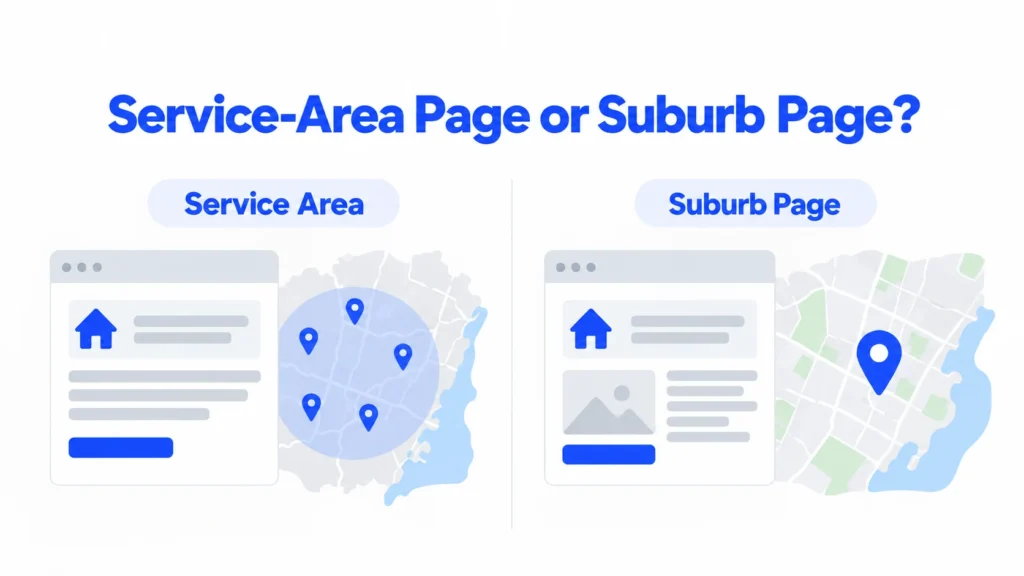
Learn when an Australian service business needs suburb pages, what useful location pages should include, and how to evaluate local SEO and…
Read guide