For years, searching online followed a familiar pattern.
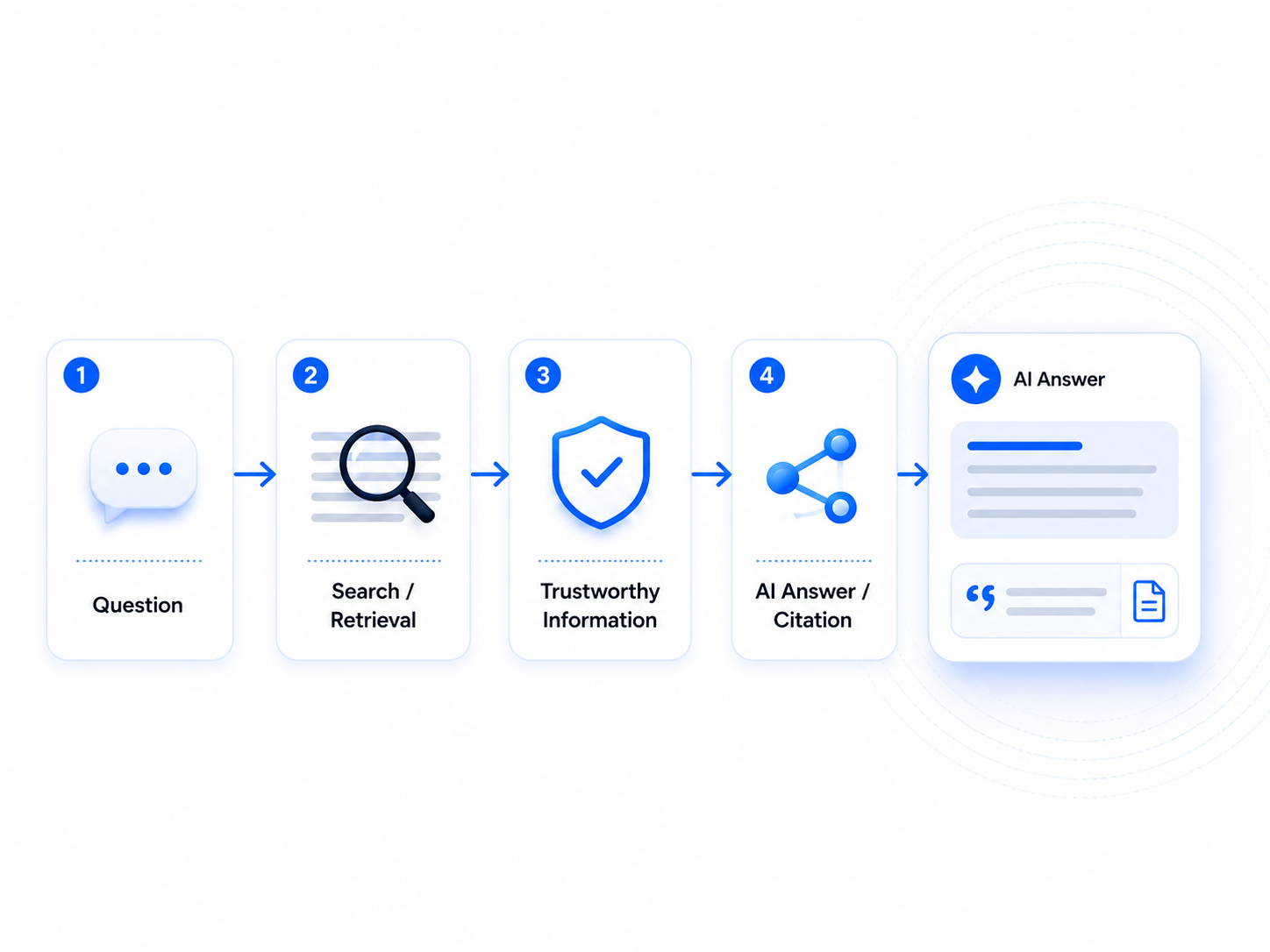
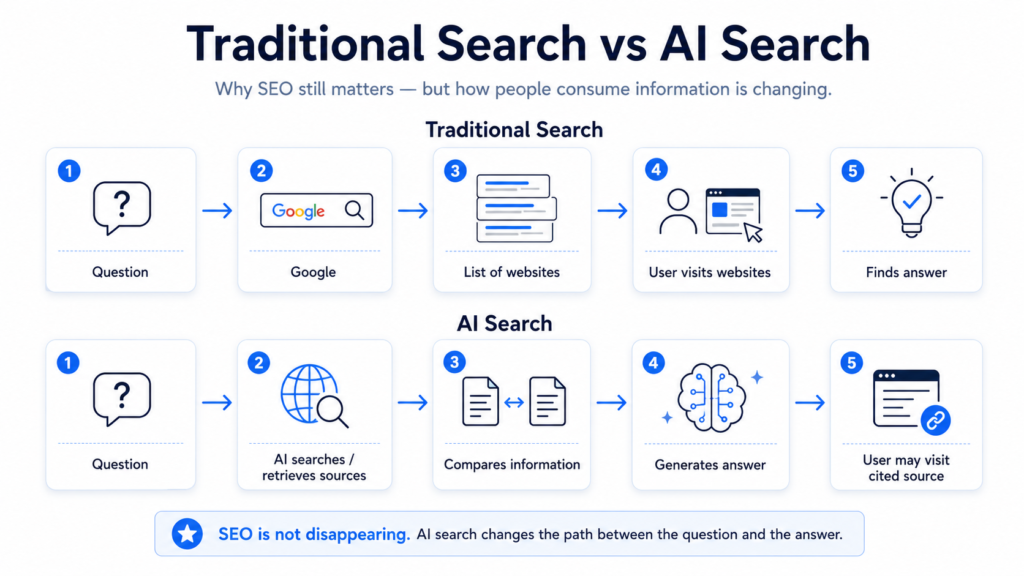
You opened Google, typed a few words, scanned ten blue links, opened three or four websites, compared the information, went back to Google, changed your search, and repeated the process until you found what you needed.
AI search changes that behaviour.
Instead of searching:
best website designer Sydney
someone can now ask:
“I run a small plumbing business in Sydney. I need a company that can rebuild my website, improve my Google visibility and help me generate enquiries. Who should I consider?”
The user isn’t necessarily looking for ten websites anymore.
They are looking for an answer.
ChatGPT can search the web, collect information from different sources, compare what it finds and turn it into one response.
That creates a new question for businesses:
How do you become one of the businesses, websites or sources that AI finds and uses when creating that answer?
That is what this guide is about.
And the first thing to understand is this:
You do not simply “rank #1 in ChatGPT”
There is no known ChatGPT equivalent of a fixed Google position where your website permanently sits at #1 for a keyword.
OpenAI says ChatGPT Search ranks results using multiple factors intended to help users find relevant and reliable information, and explicitly states that top placement cannot be guaranteed.
A better way to think about AI visibility is:
Can AI discover you?
Can it understand what your page is about?
Does your content actually answer the user’s question?
Is the information credible enough to trust?
Is it useful enough to include in the final answer?
And if the user is asking for a company, product or service:
Does the available information give the AI enough confidence to recommend you?
That is a very different mindset from simply putting a keyword into a page twenty times.
The Short Answer: How Do You Rank in ChatGPT?
If you only remember one section of this guide, remember this.
To improve your chances of appearing in ChatGPT and other AI search experiences:
- Make sure AI search crawlers can access your website.
- Build a technically sound website that search engines can discover and index.
- Create content around real questions people ask, not just short keywords.
- Answer those questions clearly and early.
- Cover important topics properly instead of publishing thin articles.
- Support factual claims with credible evidence and original sources.
- Add information, experience or data that other websites do not simply repeat.
- Make your business and expertise easy to identify across the web.
- Keep important information accurate and current.
- Measure citations, referrals and AI visibility instead of focusing only on traditional rankings.
None of those guarantees a ChatGPT citation.
Together, however, they make your website substantially easier for search systems and AI assistants to discover, understand and use.
Now let’s understand why.
How Does ChatGPT Search Actually Work?
This is where AI search becomes interesting.
A user might ask ChatGPT:
“How can a local business rank in AI search?”
ChatGPT does not necessarily take that exact sentence and search it once.
OpenAI explains that ChatGPT Search may rewrite a user’s request into one or more targeted search queries and send those queries to search providers. It can then perform additional searches as it learns more about what is needed to answer the original question.
So one conversational question could potentially turn into searches around:
- AI search visibility for businesses
- local business ChatGPT optimisation
- how businesses appear in AI answers
- AI search ranking factors
- local SEO for generative search
This is important because it changes how we should create content.
Stop thinking about one keyword. Start thinking about the entire question.
Traditional keyword research might tell you to target:
ChatGPT SEO
But someone interested in that subject could ask dozens of different questions:
- How do I rank in ChatGPT?
- How can ChatGPT find my website?
- How do I get cited by ChatGPT?
- How does ChatGPT decide which website to use?
- How do I get my business recommended by ChatGPT?
- Does traditional SEO affect ChatGPT?
- Do backlinks help with AI search?
- Does schema help AI understand my site?
- Do Google reviews influence ChatGPT recommendations?
- Does ChatGPT use Google?
- Does ChatGPT use Bing?
- Do I need an
llms.txtfile? - How do I track visitors coming from ChatGPT?
A genuinely useful article should not force someone to conduct another twelve searches after reading it.
It should anticipate those questions and answer them.
That is good content.
And conveniently, it is also good optimisation.
Step 1: Make Sure ChatGPT Can Actually Access Your Website
Before worrying about content structure, citations, schema or authority, start with the simplest question:
Can ChatGPT Search crawl the website at all?
OpenAI uses a crawler called OAI-SearchBot for search discovery.
OpenAI states that public websites can appear in ChatGPT Search and recommends allowing OAI-SearchBot if you want your content to be discovered, surfaced, cited and linked from ChatGPT.
Your robots.txt file therefore should not accidentally block it.
A basic configuration allowing the crawler can look like:
User-agent: OAI-SearchBot
Allow: /
But robots.txt is only one possible barrier.
Your:
- CDN
- firewall
- bot protection
- hosting configuration
- authentication
- rate limiting
- security plugins
can also prevent legitimate crawlers from reaching your pages.
OpenAI specifically recommends checking these infrastructure layers and, where necessary, verifying traffic against OpenAI’s published crawler IP ranges.
OAI-SearchBot and GPTBot are not the same thing
This distinction causes a lot of confusion.
OAI-SearchBot relates to surfacing public web content in ChatGPT Search.
GPTBot relates to content that may be used to improve OpenAI’s generative models.
A publisher can therefore make different decisions about search discovery and model training. OpenAI specifically explains that publishers who want their content excluded from potential training can disallow GPTBot, while allowing OAI-SearchBot for search visibility.
In simple terms:
Allowing your site to appear in ChatGPT Search does not require giving exactly the same crawler permissions for model training.
Step 2: Understand That AI Search Still Depends Heavily on Search
There is a temptation to believe that AI optimisation has completely replaced SEO.
It hasn’t.
ChatGPT Search can use external search providers when answering queries, and OpenAI specifically lists search-provider relationships as part of how web searches can be performed.
Google is even more explicit about its own AI experiences.
Google says its generative AI search features are built on top of its core Search ranking and quality systems and use techniques such as retrieval-augmented generation to find relevant and current pages from its search index.
So the fundamentals still matter:
- crawlable pages
- sensible site architecture
- descriptive titles
- useful headings
- internal linking
- canonical URLs
- fast loading
- mobile usability
- useful page content
- backlinks and mentions
- accurate business information
- a website that search engines can understand
Google’s own guidance for AI Overviews and AI Mode specifically says existing SEO fundamentals remain worthwhile.
SEO isn’t disappearing.
What is changing is what happens after information is found.
Traditional search often asks:
Which pages should we rank?
Generative search increasingly also asks:
Which pieces of information from these pages are useful for answering this particular question?
That is where the next part becomes important.
Step 3: Create Content Around Intent, Not Exact Keywords
Imagine someone asks:
“How much should a small business spend on SEO?”
You could create a page stuffed with phrases such as:
SEO cost, SEO pricing, SEO company prices, SEO package price, SEO price Australia…
Or you could actually answer the question.
For example:
SEO pricing for a small Australian business can range significantly depending on competition, location, the condition of the website and how much ongoing work is required. A local service business competing in one suburb normally has very different requirements from an e-commerce store competing nationally.
The second version helps somebody.
It also provides context an AI system can use.
Microsoft’s guidance for inclusion in AI-generated answers recommends writing for intent rather than simply keywords, using precise language and providing enough context for systems to understand what information means.
This does not mean keywords are useless.
Keywords help us understand demand.
But keywords are a clue to the question, not the final objective.
Build question clusters
Suppose your core subject is:
How to rank in ChatGPT
Instead of producing one article and leaving it there, build supporting resources around the questions naturally connected to it:
Main guide
How to Rank in ChatGPT and AI Search
Supporting guides
- How Does ChatGPT Choose Which Businesses to Recommend?
- SEO vs GEO vs AEO: What’s the Difference?
- Can ChatGPT Find Your Website?
- Does Schema Help With AI Search?
- How to Track Traffic From ChatGPT
- Do Reviews Matter for AI Recommendations?
- How Should Local Businesses Prepare for AI Search?
- How to Write Content AI Can Understand and Cite
Now you are not trying to own a keyword.
You are building a useful library around a subject.
Step 4: Answer the Question Before Writing an Essay About It
One of the simplest improvements you can make to your content is to stop hiding the answer.
If the heading is:
Does schema help you rank in ChatGPT?
Do not begin with:
“In today’s rapidly evolving digital landscape, artificial intelligence has fundamentally changed how businesses…”
Just answer.
For example:
Schema can help search systems understand structured information about a page, but OpenAI has not publicly identified schema markup as a direct ChatGPT Search ranking factor. It should be treated as part of good technical SEO rather than a shortcut to AI rankings.
Then explain why.
This creates a useful structure:
Question
↓
Direct answer
↓
Explanation
↓
Evidence
↓
Examples
↓
Nuance or exceptions
That structure works well for humans because they get the important information quickly.
It also creates clear, self-contained passages that machines can understand.
Microsoft recommends concise answers, descriptive headings, Q&A structures, lists, tables and self-contained passages because AI search systems may parse content into smaller pieces when assembling answers.
But there is an important warning here.
Do not destroy your writing just to create tiny “AI chunks”
Google explicitly says there is no requirement to divide content into artificially small chunks for its generative AI search features. Pages should still be designed around what works best for the reader and subject.
So the principle isn’t:
Make every paragraph two sentences because AI likes it.
The principle is:
Make every section clear enough that both a person and a machine can understand what it is saying.
Step 5: Make Important Statements Self-Contained
Consider this sentence:
“This is why it is important.”
Important what?
If an AI system retrieves that sentence without the previous paragraph, it provides almost no information.
Now compare it with:
Keeping your business name, address and contact details consistent across major online platforms reduces ambiguity about which business each listing refers to.
That sentence makes sense by itself.
You do not need to turn your entire article into robotic statements.
But important definitions, conclusions, statistics and answers should contain enough context to stand on their own.
Microsoft calls this kind of information “snippable”: information that can be extracted cleanly and reused as part of an AI-generated answer.
That creates a useful writing rule:
Write sentences worth citing.
Not sentences written for a robot.
Sentences a human would genuinely want to quote because they explain something well.
Step 6: Reliability Matters More When AI Is Answering for You
If you’re reading ten websites yourself, you can judge them.
You can notice that one looks suspicious.
You can compare another source.
You can reject information that doesn’t make sense.
When an AI system generates the answer, some of that filtering happens before the user reaches your website.
That makes credibility incredibly important.
OpenAI says ChatGPT Search ranking considers factors designed to surface relevant and reliable information.
Microsoft similarly recommends supporting claims with examples, evidence, data and cited sources when creating material that may be referenced by AI-generated answers.
So instead of:
“AI search is growing incredibly fast.”
Use evidence where that claim matters.
Instead of:
“Schema guarantees higher AI rankings.”
Check whether anyone responsible for the system has actually said that.
Instead of:
“Businesses with more reviews always get recommended by ChatGPT.”
Explain what is known, what is likely, and what has not been confirmed.
Your content becomes more trustworthy when you’re willing to say “we don’t know.”
That may sound strange in marketing.
But compare these two companies:
Company A
“We discovered the 17 secret ChatGPT ranking factors that guarantee #1 placement!”
Company B
“OpenAI does not publish a complete ranking formula. Here is what OpenAI has confirmed, what other search providers recommend, and what currently remains an inference.”
Which one would you trust?
Probably the second.
Your reader is not stupid.
Neither are search systems.
Step 7: Use Primary Sources Whenever You Can
If OpenAI explains how OAI-SearchBot works, cite OpenAI.
If Google explains how AI Mode retrieves information, cite Google.
If Microsoft describes how Bing handles AI citations, cite Microsoft.
Do not cite:
randommarketingblog.com
which cites:
anotherseoblog.com
which quotes:
a LinkedIn post
about something OpenAI supposedly said.
Go as close to the original source as possible.
For example, this article relies heavily on primary documentation from OpenAI, Google and Microsoft because those organisations actually operate the systems being discussed.
That does two things.
It gives readers somewhere credible to verify important claims.
And it forces us as writers to separate fact from speculation.
Step 8: Don’t Just Repeat What Already Exists
This may become one of the biggest differences between average content and excellent content.
There are already thousands of articles explaining:
“What is SEO?”
The internet does not desperately need another 800-word version containing the same five definitions.
Google’s latest guidance around generative AI search repeatedly emphasises creating valuable, unique and non-commodity content rather than publishing material that simply recreates information already available elsewhere.
This is where experience becomes powerful.
A digital agency could publish:
Generic article:
“Google reviews are important for local businesses.”
Or it could publish:
“We Analysed the Businesses ChatGPT Recommended for 100 Local Service Searches in Sydney. Here’s What We Found.”
The second article can contain information that didn’t exist before the research was conducted.
For example:
- how frequently recommended businesses appeared in traditional organic search
- average review counts
- rating distributions
- whether they had detailed service pages
- whether they appeared in major directories
- whether the business name was consistent across platforms
- how often the company had third-party mentions
- what types of pages ChatGPT cited
- whether citations changed when prompts were worded differently
Now your business isn’t simply summarising knowledge.
It is creating knowledge.
That creates something other publishers can reference.
Something journalists can cite.
Something AI systems can retrieve.
And something genuinely useful for your audience.
Step 9: Build Topic Depth Instead of Publishing Random Articles
Authority isn’t created because a website has 100 blog posts.
A plumbing company publishing:
- Top 5 Marketing Tips
- What Is Artificial Intelligence?
- Best Christmas Gifts
- How to Start a Business
- Benefits of Plumbing
- Facebook Advertising Tips
has a lot of content.
But what exactly is that website an expert in?
Instead, imagine a plumber builds a library around blocked drains:
- Why Does My Drain Keep Blocking?
- Tree Roots in Drain Pipes: Signs and Solutions
- How Much Does Drain Cleaning Cost in Sydney?
- Hydro Jetting vs Traditional Drain Cleaning
- Can I Unblock a Drain Myself?
- When Is a Blocked Drain an Emergency?
- Why Does My Shower Drain Smell?
- How CCTV Drain Inspections Work
- How to Prevent Tree Roots Entering Pipes
That website gives both people and machines far more evidence about its subject expertise.
Bing’s AI Performance guidance specifically recommends strengthening depth and expertise around related grounding queries and examining which subject areas receive citations.
This is the point of a topic cluster.
You don’t publish content because Tuesday is “blog day.”
You build the most useful resource you can around the problems your customers actually have.
Step 10: Do Backlinks Still Matter for ChatGPT?
Probably indirectly.
But be careful with this answer.
OpenAI has not publicly said:
“ChatGPT ranks websites using Domain Authority and backlinks.”
So nobody should confidently present that statement as fact.
However, backlinks and legitimate external mentions remain important parts of traditional search discovery and authority.
Microsoft specifically includes backlinks among the traditional SEO foundations that continue to matter for discoverability in AI search.
And because AI search systems can rely on search infrastructure and web retrieval, signals affecting discoverability and authority in search can reasonably influence which sources become available for AI retrieval.
That is different from claiming:
“100 backlinks = higher ChatGPT ranking.”
We do not have evidence for a formula like that.
The smarter objective is:
Earn mentions because you’ve created something worth mentioning.
A genuine mention from:
- an industry publication
- local organisation
- professional association
- supplier
- customer
- newspaper
- specialist website
- research paper
- respected creator
can help people discover you and strengthen your wider web presence.
Do that because it builds authority across the internet, not because somebody sold you “500 GEO backlinks.”
Step 11: Does Schema Markup Help With ChatGPT Rankings?
Schema is useful.
Schema is not magic.
Structured data can help search engines understand specific information on a webpage, such as:
- the organisation behind the website
- products
- services
- articles
- breadcrumbs
- events
- reviews where eligible
Microsoft recommends structured data as one way to clarify information for search systems and AI experiences.
Google also continues to recommend using relevant structured data as part of normal SEO, provided it accurately matches the visible content on the page.
But Google explicitly warns businesses not to overfocus on structured data as an AI-search trick and says there is no special schema required specifically for its generative AI experiences.
And OpenAI has not publicly announced a special “ChatGPT schema” that guarantees inclusion.
So:
Use schema to describe your content accurately. Don’t use schema as a substitute for useful content, credibility or authority.
Step 12: Do You Need an llms.txt File?
You may have seen llms.txt promoted as the AI equivalent of robots.txt.
At the moment, you should not treat it as a universal AI-ranking requirement.
Google explicitly states that it does not require or use llms.txt for visibility in Google Search or its generative AI search experiences. Google says adding one neither improves nor damages Google Search rankings.
OpenAI’s official instructions for appearing in ChatGPT Search focus on allowing OAI-SearchBot and ensuring the crawler can access your site. OpenAI does not currently identify llms.txt as a requirement for ChatGPT Search inclusion in its publisher guidance.
That may evolve.
AI search is changing quickly.
But today, spending hours perfecting an llms.txt file while your actual website contains thin, outdated content would be getting the priorities backwards.
Step 13: Keep Your Information Fresh
Imagine you publish:
“How Much Does Google Ads Cost in Australia?”
The numbers might be useful today.
Three years later, the market may have changed.
Or imagine a business changes:
- phone number
- address
- opening hours
- prices
- services
- staff
- warranty
- product availability
but half the internet still shows the old information.
AI cannot magically know which version you intended to be correct.
Bing recommends keeping cited content current and accurate, and its AI Performance tools are specifically designed to show how citations and referenced pages change over time.
For important evergreen articles, use a real maintenance process:
Published: August 2026
Last reviewed: August 2026
Then actually review it.
Do not automatically change the date every month to pretend an old article is new.
Freshness is useful when the information itself is genuinely fresh.
Step 14: Make Your Business an Easy Entity to Understand
Content isn’t the whole story.
Suppose someone asks:
“Who offers custom gift boxes in Parramatta?”
Or:
“Recommend a mobile detailer near me.”
The AI needs to establish facts such as:
- Does the business exist?
- What is it called?
- What does it actually offer?
- Where does it operate?
- Is it still open?
- What do customers say about it?
- What is its website?
- Does information from different sources agree?
For local businesses, Bing recommends maintaining accurate business details and specifically points business owners towards Bing Places to keep address, hours and contact information current for AI-driven experiences.
Google similarly recommends keeping Business Profile and other relevant business information up to date for visibility across its search and AI experiences.
For a real business, aim for consistency across:
- your website
- Google Business Profile
- Bing Places
- major social profiles
- industry directories
- relevant local directories
- reputable third-party mentions
That doesn’t mean joining 400 spam directories.
It means making sure that wherever legitimate information about your business appears, it tells a consistent story.
Step 15: Reviews Matter — But Don’t Invent a ChatGPT Review Formula
Do reviews influence whether people trust a business?
Absolutely.
Do local search systems use review and reputation information in various ways?
Yes.
Can ChatGPT discover information about reviews when searching the web?
Yes.
Can we say:
“You need exactly 73 Google reviews with a 4.8 rating to rank in ChatGPT?”
No.
OpenAI has not published a formula like that.
Reviews should therefore be approached for what they really are:
evidence of customer experience and reputation.
Get genuine reviews because customers use them to make decisions.
Respond professionally.
Do not buy reviews.
Do not create fake reputation signals because somebody told you AI will count them.
AI search optimisation should strengthen your actual business, not create a fake version of it for algorithms.
Step 16: Write Content That Contains Evidence
Which sentence is more useful?
Version A
Website speed is extremely important.
Version B
Website speed can influence user experience and search performance; when discussing a specific performance claim, we should support it with measurements or a credible primary source.
The second sentence tells you why and establishes what would count as evidence.
Good informational pages naturally include useful evidence such as:
- statistics
- definitions
- examples
- comparisons
- original observations
- step-by-step processes
- calculations
- expert explanations
- screenshots
- testing methodology
- primary-source citations
Recent academic work studying generative-engine visibility has also found that citation and answer influence are not necessarily the same thing, and that well-structured pages containing extractable evidence such as definitions, numerical facts, comparisons and procedural information can be especially useful within generated answers.
Treat research like this carefully.
It is useful evidence about generative search behaviour.
It is not a leaked ChatGPT ranking algorithm.
That’s an important difference.
Step 17: Does Adding Citations Help You Rank?
Citations improve the quality and verifiability of your content.
That alone makes them worthwhile.
One of the earliest influential papers on Generative Engine Optimisation tested several content changes in a controlled generative-engine environment and reported that certain approaches, including adding citations, quotations and statistics, could improve measured visibility in that experimental setting. Results varied significantly by query and domain.
That research helped establish the idea of Generative Engine Optimisation, or GEO.
But don’t turn the result into:
“Add three statistics to every article and ChatGPT will rank it.”
The experiment does not prove that.
The safer lesson is much simpler:
Well-supported information is more useful than unsupported claims.
That’s true for readers whether an AI engine exists or not.
Step 18: SEO, GEO and AEO — Do You Really Need Three Strategies?
You will hear several terms:
SEO — Search Engine Optimisation
Improving visibility in traditional search engines.
AEO — Answer Engine Optimisation
Creating information that can answer specific questions clearly.
GEO — Generative Engine Optimisation
Improving how content participates in generative AI results and answers.
The terminology can be useful.
But don’t let it complicate something that is fundamentally straightforward.
Google’s own generative AI guidance says traditional SEO best practices remain foundational and warns against chasing unsupported “AEO/GEO hacks.”
Microsoft has openly adopted GEO terminology in Bing Webmaster Tools, describing it as understanding how publisher content participates in AI-generated experiences and citations.
Our view is:
GEO is not a reason to abandon SEO. It is an extension of how we think about discoverability, clarity, authority and usefulness when the final search result may be an AI-generated answer rather than a list of links.
Step 19: Can AI-Generated Content Rank in AI Search?
Using AI does not automatically make content bad.
And writing something manually does not automatically make it good.
The question is:
What value did you actually create?
Google says generative AI can be useful for research and structuring original content, but generating large numbers of pages without adding meaningful value can violate its policies around scaled content abuse.
Think of AI as a tool.
It can help:
- organise research
- identify questions you forgot
- compare concepts
- improve grammar
- structure a draft
- explain complicated material
- brainstorm examples
But somebody still needs to ask:
- Is this correct?
- Is it useful?
- Is the source credible?
- Did we add anything original?
- Would I trust this advice?
- Have we actually answered the reader?
- Is there something here that deserves to exist?
Publishing 500 AI-generated articles isn’t a content strategy.
It’s just pressing publish 500 times.
Step 20: Can a Small Website Appear in ChatGPT?
Yes.
OpenAI says any public website can potentially appear in ChatGPT Search, provided it is accessible, although inclusion and placement are never guaranteed.
A small website does not automatically lose simply because a giant publisher exists.
This can actually create an opportunity.
A specialist business may know something more deeply than a huge general website.
For example:
A national publication might have:
Guide to Car Detailing
A local detailing company could have:
How Sydney’s Coastal Air, Summer Heat and Street Parking Affect Car Paint
Which one contains more specialised information for a Sydney driver asking that specific question?
Specialisation creates opportunities.
You may never become the world’s biggest website.
You can still become one of the web’s best sources for a narrow problem.
Step 21: Does ChatGPT Always Search the Internet?
No.
ChatGPT can answer many questions without conducting a live web search.
OpenAI says ChatGPT can automatically search when a question may benefit from current web information, while users can also explicitly initiate web search.
This means there are two concepts that businesses sometimes confuse:
Being present in ChatGPT Search
Your current website is retrieved or cited during a web-enabled answer.
Being represented in a model’s existing knowledge
Information may already be part of what a model has learned or otherwise knows.
Those are not the same thing.
For businesses trying to improve visibility today, search discovery is the more practical target, because you can maintain your live website and make current information accessible to search systems.
Trying to “make ChatGPT memorise my company” is not a sensible marketing strategy.
Step 22: What About Exact-Match Keywords?
Don’t abandon keywords.
But stop worshipping them.
AI systems are capable of understanding related wording and meaning.
Google explicitly advises publishers that they do not need to rewrite pages purely for generative AI or capture every possible long-tail variation because its systems can understand synonyms and general meaning.
If you’re writing about:
emergency plumbing
naturally related language might include:
- burst pipe
- urgent plumber
- water leak
- after-hours plumbing
- blocked drain
- emergency call-out
- leaking hot water system
You don’t need to awkwardly repeat:
“best emergency plumber Sydney emergency plumbing Sydney emergency plumber near me”
Use the language necessary to explain the topic completely.
Step 23: Is Longer Content Better?
There is no perfect word count.
A complete answer to:
“What time does your shop close?”
might require four words.
A complete answer to:
“How do I rank in ChatGPT?”
might require several thousand.
Google explicitly states that there is no ideal page length for generative AI search and recommends creating pages around what the audience and subject actually require.
So don’t write 4,000 words because somebody said Google loves 4,000 words.
And don’t reduce an important guide to 600 words because somebody said AI prefers short content.
Use enough words to solve the problem.
Then stop.
Step 24: Make the Website Easy for Humans First
There is an irony in AI optimisation.
The more people chase algorithms, the worse their websites can become.
You see pages covered in:
- repetitive FAQs
- robotic sentences
- hundreds of keywords
- enormous tables nobody wants
- fake “expert” quotes
- intrusive pop-ups
- fabricated statistics
- unnecessary schema
- copy written solely for bots
Don’t do that.
Google’s advice remains strongly people-first: create original, useful content that satisfies the person who arrived on the page.
And this should be the standard anyway.
If AI sends somebody to your website and they hate the website, what did you actually win?
Visibility without usefulness is not success.
Step 25: How Do You Track Whether ChatGPT Is Sending You Traffic?
This part is becoming easier.
OpenAI says links from ChatGPT Search automatically include:
utm_source=chatgpt.com
which allows publishers to identify ChatGPT referral traffic in analytics platforms such as Google Analytics.
So one useful measurement is:
How many people actually reach your website from ChatGPT?
But traffic is only one part of AI visibility.
Microsoft introduced AI Performance in Bing Webmaster Tools in 2026, providing publishers with information including:
- total AI citations
- pages being cited
- citation activity over time
- grounding query information
for supported Microsoft AI experiences.
Google has also begun introducing dedicated generative-AI performance reporting in Search Console for visibility within features such as AI Overviews and AI Mode.
Over time, businesses should therefore think about metrics such as:
Traditional visibility
- impressions
- keyword rankings
- organic clicks
- backlinks
AI visibility
- AI citations
- pages cited
- ChatGPT referral traffic
- prompts or grounding queries associated with citations
- AI-assisted leads
- brand mentions in generated recommendations
Business outcomes
- enquiries
- phone calls
- appointments
- purchases
- qualified leads
- revenue
Because ultimately, being cited by an AI is nice.
Being cited by an AI that introduces you to a future customer is better.
A Practical AI Search Checklist
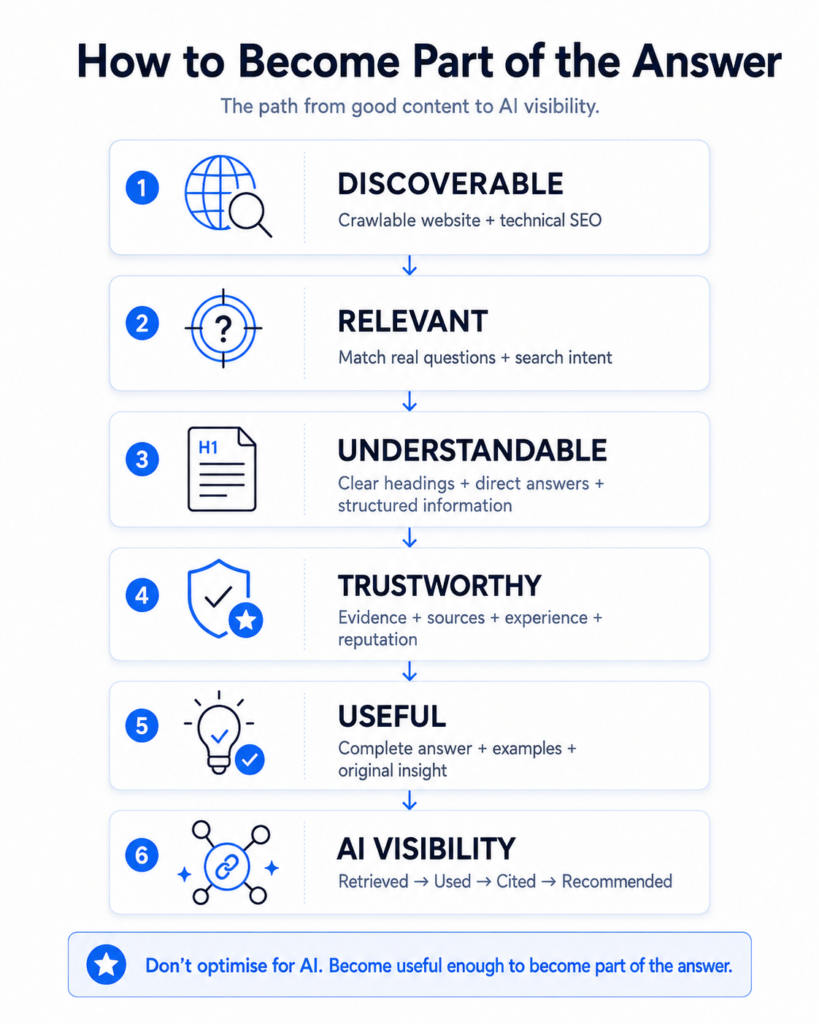
If you want to improve your website’s chances of being discovered and used by AI search systems, start here.
Technical
- Allow OAI-SearchBot if you want ChatGPT Search visibility.
- Check that your CDN or firewall is not blocking legitimate crawlers.
- Maintain a valid sitemap.
- Make important pages internally discoverable.
- Avoid accidental
noindexdirectives. - Use canonical URLs correctly.
- Ensure important information exists as accessible HTML text.
- Keep mobile usability and page experience strong.
- Use appropriate structured data where it genuinely applies.
Content
- Identify real questions customers ask.
- Answer the main question early.
- Use descriptive headings.
- Explain terminology.
- Include examples.
- Include comparisons when useful.
- Support important factual claims.
- Link to primary sources.
- Add your own experience where relevant.
- Remove filler.
- Update information when it changes.
- Build related resources around important subjects.
Trust
- Clearly identify the business behind the website.
- Explain relevant experience and expertise.
- Avoid fabricated statistics.
- Avoid fake reviews.
- Avoid fake author profiles.
- Cite credible sources.
- Correct mistakes.
- Distinguish opinion from fact.
- Make claims you can defend.
Business Presence
- Keep your website details accurate.
- Maintain your major business profiles.
- Keep your business name consistent.
- Maintain accurate contact information.
- Earn genuine customer reviews.
- Earn legitimate third-party mentions.
- Build reputation outside your own website.
Measurement
- Track
chatgpt.comreferrals. - Review pages receiving AI traffic.
- Use Bing Webmaster Tools’ AI Performance reporting where available.
- Monitor Google’s generative AI Search Console reports where available.
- Test important customer questions periodically.
- Measure enquiries and sales, not just citations.
What Should You NOT Do?
AI search has created an entire new market of shortcuts.
Be sceptical when somebody promises:
“Guaranteed ChatGPT rankings”
OpenAI explicitly says top placement cannot be guaranteed.
“Install this special AI schema”
There is no universal special schema that guarantees AI inclusion.
“Create llms.txt and you’ll rank”
Google explicitly says llms.txt has no impact on its Search rankings or generative AI visibility.
“Write only 40-word paragraphs because AI chunks content”
Structure matters, but Google specifically says artificial chunking is not required.
“Buy hundreds of AI mentions”
Inauthentic mentions are not a sustainable authority strategy, and Google specifically warns against chasing them as a generative-search tactic.
“SEO is dead”
Google’s generative search continues to depend on its core ranking systems, while Microsoft continues to describe crawlability, metadata, linking and authority as foundations for AI visibility.
Most shortcuts become much less exciting when you read the documentation.
So What Actually Changes From Traditional SEO?
Less than some marketers claim.
And more than others realise.
The fundamentals remain:
Be discoverable. Be relevant. Be credible. Be useful.
But the interface between the user and the information is changing.
With traditional search:
Question → Search results → Website → Answer
With generative search:
Question → Retrieval → Multiple sources → AI-generated answer → Website when further information is needed
That changes the role your content can play.
Your page is no longer competing only to receive a click.
It may also be competing to become part of the answer itself.
And that means an important sentence buried halfway through your article can sometimes matter just as much as the page as a whole.
The Best AI Search Strategy Is Surprisingly Human
After all the terminology—SEO, GEO, AEO, RAG, grounding, citations, schema, crawlers—the strategy eventually comes back to something simple.
Imagine somebody asks you a question in person.
What would make them trust your answer?
You would:
- understand what they actually asked
- answer clearly
- explain anything confusing
- show your reasoning
- provide evidence when necessary
- admit when something is uncertain
- give practical examples
- use your experience
- avoid wasting their time
- point them somewhere reliable if they want to verify something
That is also an excellent content strategy.
We can summarise the entire guide in one sentence:
To improve your visibility in AI search, become easy to discover, easy to understand, credible enough to trust and useful enough to become part of the answer.
Not because ChatGPT needs another website optimised for ChatGPT.
Because the person asking the question needs a good answer.
And ultimately, that is what search optimisation was supposed to be about in the first place.
Frequently Asked Questions About Ranking in ChatGPT
Can I guarantee that my website will appear in ChatGPT?
No. OpenAI explicitly states that placement in ChatGPT Search is not guaranteed. You can improve your eligibility and overall discoverability, but no legitimate agency can guarantee a particular organic ChatGPT placement.
Can any website appear in ChatGPT Search?
OpenAI says any public website can potentially appear. Publishers who want their content included should make sure OAI-SearchBot is not blocked.
Does traditional SEO help with ChatGPT?
Traditional SEO remains highly relevant because AI search still depends on web discovery and search infrastructure. However, OpenAI does not publish a complete list of direct ranking factors, so specific Google or Bing ranking signals should not automatically be described as confirmed ChatGPT factors.
Is GEO replacing SEO?
No. GEO is better understood as an additional way of thinking about how content is discovered, retrieved, cited and used inside generative answers. Google’s official position is that traditional SEO fundamentals remain important for its generative AI search experiences.
Do backlinks help me rank in ChatGPT?
They can improve traditional search authority and broader web visibility, but OpenAI has not publicly stated that backlinks are a direct ChatGPT Search ranking factor. Focus on earning legitimate mentions rather than buying links specifically for “ChatGPT rankings.”
Does schema help with AI search?
Structured data can make information clearer to search engines and remains useful for traditional SEO, but there is no special schema that guarantees ChatGPT or generative-AI rankings. Google explicitly says no special structured data is required for its AI features.
Do I need llms.txt?
Not for Google Search, which explicitly says it ignores llms.txt for ranking purposes. OpenAI’s current publisher documentation does not list it as a requirement for ChatGPT Search either.
Should I write content differently for AI?
You should write more clearly, answer questions properly and support claims where necessary—but do not make your content robotic. Both Google and Microsoft continue to emphasise useful, understandable content intended for real people.
Should every blog have FAQs?
No. Include FAQs when they answer genuine follow-up questions that the main article hasn’t already covered naturally. Adding twenty repetitive questions solely because you believe AI “likes FAQs” doesn’t make the page more useful.
How long should an AI-optimised blog be?
As long as necessary to answer the subject properly. There is no universal ideal word count. Google explicitly says page length should depend on the audience and topic rather than an arbitrary generative-AI formula.
Can AI-generated articles rank?
AI-assisted content can perform well when it is accurate, original and genuinely useful. Mass-producing pages with little value is a different matter and can conflict with Google’s policies around scaled content abuse.
Does ChatGPT always search the web before answering?
No. ChatGPT can answer without live search, but it can automatically search when up-to-date web information would improve the answer, and users can explicitly request web search.
How can I tell if ChatGPT is sending visitors to my website?
OpenAI adds utm_source=chatgpt.com to referral links from ChatGPT Search, allowing website owners to identify that traffic in analytics tools such as Google Analytics.
How long does it take to rank in ChatGPT?
There is no published timeframe. Discovery, indexing, search visibility, authority and citation behaviour can all change independently. A technically accessible page may be discovered quickly while meaningful authority around a competitive topic can take considerably longer.
Can a new or small business appear?
Yes. Being small does not automatically exclude a website from ChatGPT Search. The strongest opportunity for smaller businesses is often to become exceptionally useful around a specific problem, service, location or area of expertise rather than competing broadly against the largest publishers.
Final Thought
The biggest mistake businesses can make with AI search is trying to optimise for AI instead of for the person using AI.
The technology may continue changing.
ChatGPT will change.
Google will change.
Search interfaces will change.
The acronyms will definitely change.
But somebody will still have a problem.
They will still ask a question.
And somewhere, a system will need reliable information to answer it.
Build the website that provides that information better than anyone else.
Then make sure the machines can find it.
Primary References & Further Reading
OpenAI — ChatGPT Search documentation: explains query rewriting, search providers, citations and how web search operates.
OpenAI — Publishers and Developers FAQ: explains OAI-SearchBot, crawler access, search visibility and ChatGPT referral tracking.
Google Search Central — Optimising for Generative AI Features: official guidance covering SEO foundations, original content, llms.txt, structured data, content structure and GEO/AEO misconceptions.
Microsoft Bing — Optimising Content for Inclusion in AI Search Answers: guidance covering content structure, clarity, headings, Q&A, schema, evidence and extractable answers.
Microsoft Bing Webmaster Tools — AI Performance: documentation covering AI citations, grounding queries, cited pages, freshness, topic expertise and local business information.
Aggarwal et al. — “GEO: Generative Engine Optimization”: foundational academic work exploring how content changes can influence visibility in controlled generative-engine environments.
READY FOR THE NEXT STEP?
Put the advice into practice.
If you want help improving how your business is found, trusted and contacted online, we can work out the right next step with you.
Start a Conversation