Do business directories and citations still matter for AI search?
Business directories still matter for local visibility, but citation volume is not a proven AI ranking factor. Here’s what Australian service businesses should prioritise.
Business directories still matter for local visibility, but citation volume is not a proven AI ranking factor. Here’s what Australian service businesses should prioritise.
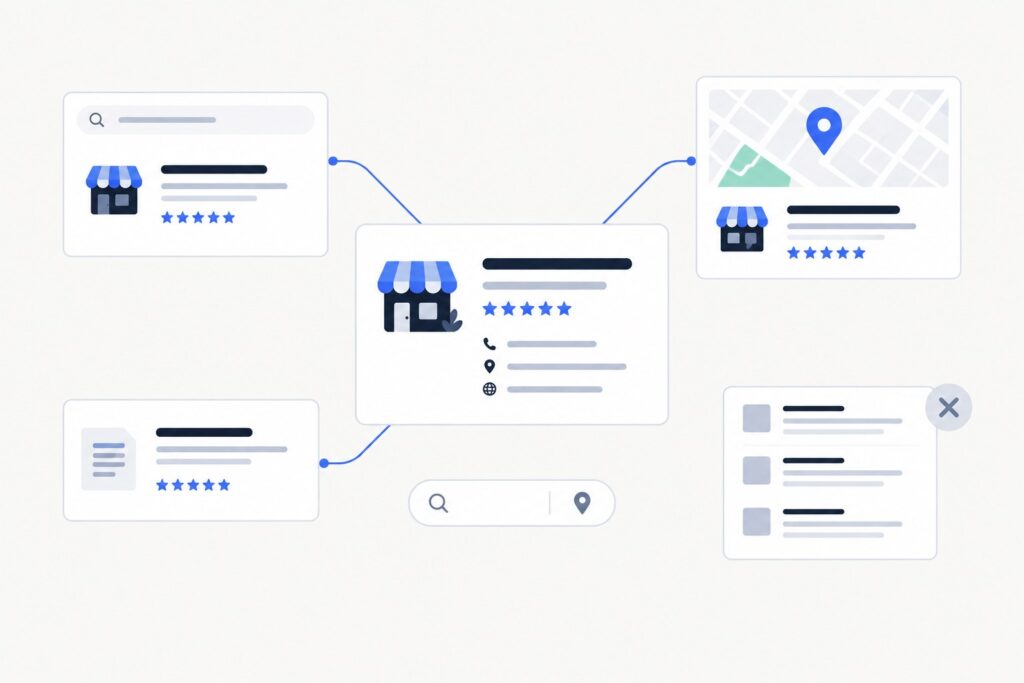
Yes — business directories and local citations still matter, but not because there is a proven rule saying “more citations = higher AI rankings”.
For an Australian service business, accurate listings on major search platforms and reputable industry or local directories can still support discoverability, local search visibility and clearer public information about the business. Those things can also matter to AI-powered search systems that retrieve information from the web or from search infrastructure.
What the evidence does not establish is that submitting your business to 50, 100 or 500 directories will make ChatGPT recommend you more often.
The useful strategy in 2026 is therefore much simpler: be accurately represented in the places that genuinely matter, rather than chasing citation volume.
A business directory is a website or platform that lists information about businesses. A citation is a mention of your business details on another website, often including some combination of your business name, address, phone number, website, category or opening hours.
For a local service business, that might include major search-platform listings, an industry association, a local chamber or trade directory, a reputable marketplace, or another legitimate site customers actually use.
Historically, local SEO advice often focused heavily on building large numbers of citations and keeping the business’s name, address and phone number — usually shortened to NAP — consistent everywhere.
Some of that advice is still useful. But the reason needs to be more precise.
There is direct evidence that accurate business information and broader web signals matter to Google’s local-search ecosystem.
Google says local results are mainly based on relevance, distance and prominence. Its current local-ranking guidance describes prominence as how well-known a business is and specifically points to signals such as websites linking to the business and customer reviews.
Google’s current wording does not identify directory citation count as a standalone ranking factor. That is an important distinction: reputable directory listings can still be useful sources of accurate public business information, but they should not be treated as a guaranteed Google ranking lever.
Google also says complete and accurate business information makes a business more likely to appear for relevant local searches. For a plumber, electrician, cleaner or landscaper, the practical lesson is that Google should not have to untangle conflicting basic facts about who you are, what you do and where you operate.
See Google’s current local ranking guidance for the documented factors.
No direct universal AI-ranking factor has been established.
This distinction matters because “AI search” covers different products with different indexes, search providers, local databases and retrieval systems.
Google says the normal SEO fundamentals that make content eligible and useful in Search also apply to AI Overviews and AI Mode. Its guidance recommends keeping important business information, including Google Business Profile information, current. Google does not tell businesses to build a particular number of directory citations to qualify for its AI features.
OpenAI’s current guidance is similarly cautious. OpenAI says public websites can appear in ChatGPT Search and recommends allowing OAI-SearchBot so content can be discovered, surfaced, cited and linked. Its current publisher guidance does not publish a directory-specific ranking rule.
OpenAI does not currently publish a rule saying directory count, NAP consistency or citation volume directly determines whether a local business is recommended by ChatGPT.
So if someone promises that “100 citations will make you rank in ChatGPT”, the evidence does not support that claim.
The strongest case is indirect and platform-dependent.
AI search systems often need to work out basic questions such as:
If your own website says one thing while important third-party listings show an old phone number, former address or outdated business category, there is more ambiguity in the public information available about the business.
Conversely, accurate information across legitimate sources gives search and retrieval systems clearer evidence to work with.
That is a reasonable inference from how search and retrieval work; it should not be presented as a published universal ChatGPT ranking formula.
Microsoft’s documentation makes the platform-specific nature of local AI visibility particularly clear.
In February 2026, Microsoft said local businesses can register with Bing Places for Business to help keep address, hours and contact information current and eligible for inclusion in AI-generated responses across its ecosystem.
Microsoft also describes Bing Places as the platform businesses use to manage listings that appear in Bing Search and Bing Maps.
This is important for two reasons.
First, it is direct evidence that structured local-business listings can feed into an AI-search ecosystem.
Second, it shows why there is no single universal “citation strategy”. Google has Google Business Profile. Microsoft has Bing Places. Other AI products can use different search providers and sources.
The right question is not “How many directories do I need?” It is “Which sources are genuinely important to customers and to the search ecosystems where I want to be found?”
You do not need to create profiles everywhere. Use a simple priority rule: maintain a listing when it is tied to a major search ecosystem, genuinely used by customers, recognised in your industry or location, or already producing measurable business value.
If a directory fits none of those tests, it should sit behind more important work such as improving your website, Google Business Profile, reviews and core service information.
Keep your Google Business Profile accurate because it directly supports visibility in Google Search and Maps. If Bing and Microsoft’s AI experiences matter to your audience, maintain Bing Places as well.
These are not generic directory submissions. They are first-party business-data systems connected to major search ecosystems.
If your trade, profession or industry has a recognised association or directory that customers genuinely use, an accurate listing can be valuable.
The benefit is not merely “one more citation”. A relevant industry source can help customers discover the business and provide independent context about what the business does.
A genuine local business association, council-linked resource, chamber or established local directory can make sense when it is relevant to the area you serve.
Again, relevance matters more than collecting a large number of low-quality links.
If people in your market use a particular marketplace, review platform or specialist directory to find your type of service, keep that listing accurate.
A directory that produces real enquiries has business value regardless of whether anyone can prove a direct AI-ranking effect.
Consistency does not mean forcing every platform into identical formatting. “St” versus “Street”, for example, is not the business problem to obsess over.
Focus on factual consistency:
If your business changes phone number or address, update the sources that matter instead of allowing old information to remain indefinitely.
This is good customer experience first. Any search or AI-discoverability benefit is secondary.
The old “submit to as many directories as possible” mindset can create more work than value.
If a directory is obscure, irrelevant, full of spam and never used by customers, there needs to be a better reason than “an SEO checklist told me to add it”.
They matter differently.
The useful part of a citation is not the raw count. It is the fact that another legitimate source can help establish and distribute accurate information about a business.
That already matters in local search. Google explicitly says complete and accurate business information improves local-search eligibility, while prominence can be influenced by broader web signals such as links and reviews.
AI search adds another reason to care about clean public information because generative systems can retrieve, compare and synthesise information from multiple sources. This fits the broader pattern explained in our guide to ranking in ChatGPT and AI search. But the exact role of any individual directory in a particular AI answer is usually not visible, and no major platform publishes a universal citation-count formula.
That uncertainty should change the strategy from volume to quality.
Evaluate the listing like a business asset rather than an SEO tally mark. A practical rule is: keep it if it helps customers find, verify or contact you, strengthens an important platform presence, or produces measurable traffic or enquiries. If it does none of those things and requires ongoing maintenance, it is probably low priority.
For AI visibility specifically, also watch which sources are cited when relevant AI products answer questions in your market. Microsoft now provides AI citation reporting in Bing Webmaster Tools for website content, while ChatGPT referral traffic can be tracked when users click through to your site.
Do not turn one manual AI query into a ranking report. Results can vary with the wording of the question, location, freshness and the system being used.
Yes — but quality, relevance and accuracy matter more than citation volume.
For local businesses, directories can still be part of the wider public information search and AI systems may encounter. Google’s current guidance supports keeping business information complete and accurate and says broader web signals such as links and reviews can affect local prominence; Microsoft goes further by directly connecting current Bing Places business data with eligibility for AI-generated responses.
What we cannot responsibly claim is that directory citations are a universal direct ranking factor for ChatGPT or that hitting a certain citation count will improve AI recommendations.
For an Australian service business, the practical order is:
That approach supports customers, conventional local search and the broader information environment AI search relies on — without pretending we know a ranking formula the platforms have not published.
READY FOR THE NEXT STEP?
If you want help improving how your business is found, trusted and contacted online, we can work out the right next step with you.
Start a ConversationA local service business does not need to rank #1 on Google to appear in ChatGPT. Here’s what OpenAI confirms, what SEO…
Read guide
Can customers find your business when they search using ChatGPT, Google AI or Microsoft Copilot? If your website clearly explains your services,…
Read guide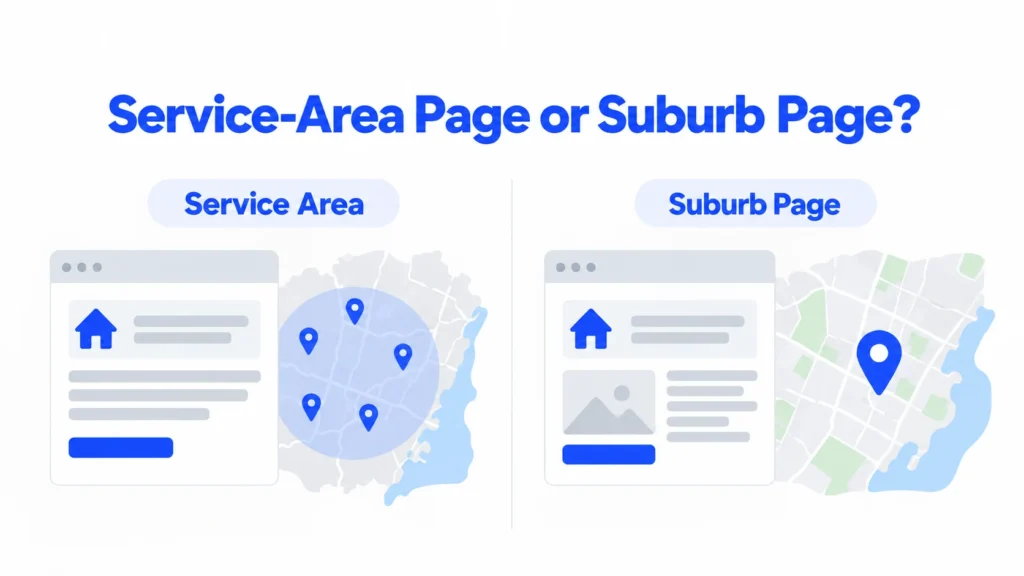
Learn when an Australian service business needs suburb pages, what useful location pages should include, and how to evaluate local SEO and…
Read guide