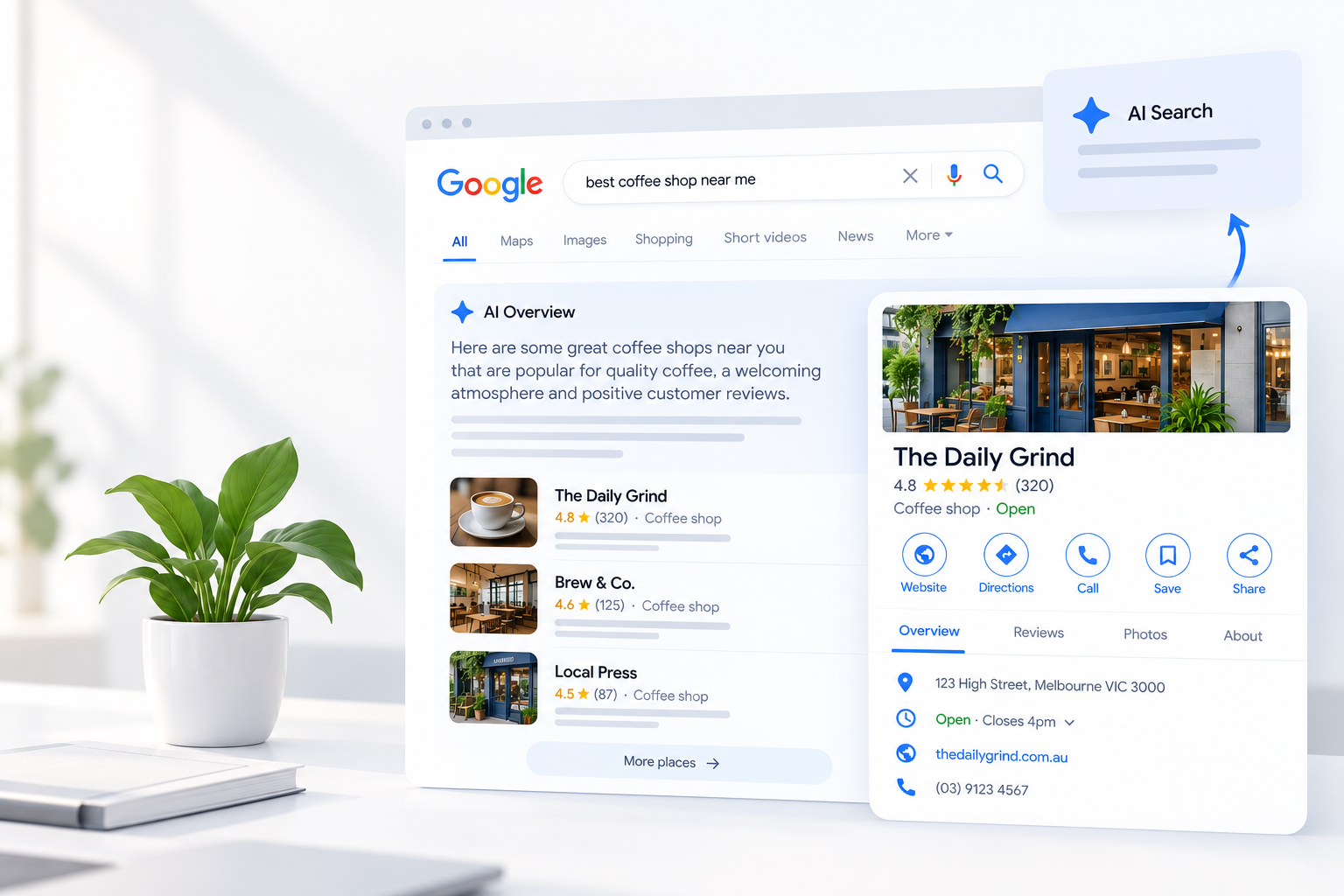
Yes — a Google Business Profile can help a local business appear in AI-powered search, especially inside Google’s own search ecosystem. But it is not a documented shortcut to being recommended by ChatGPT, and there is no evidence that simply optimising a profile creates a universal “AI ranking” boost.
For an Australian plumber, electrician, cleaner, landscaper or other local service business, the useful way to think about Google Business Profile (GBP) is as a core source of accurate local business information. Google uses Business Profiles in Search and Maps, and Google specifically recommends keeping Business Profile information up to date when discussing visibility in AI Overviews and AI Mode.
That makes GBP important. It just does not make it magic.
What Google Business Profile definitely influences
Google’s own guidance is clear about the traditional local-search role of a Business Profile. Google says local results are mainly determined by relevance, distance and prominence. It also says complete and detailed profile information helps Google understand a business and match it to relevant searches.
That means information such as your business category, address or service area, opening hours and other business details can affect whether Google understands that you are a relevant local result.
Google also says review count and review score can contribute to local ranking, while links and other information from across the web contribute to prominence. That is a much stronger evidence base than claims about secret “AI ranking factors”.
Google’s local ranking guidance explains these factors directly.
How does that connect to Google AI Overviews and AI Mode?
This is where the connection to AI search becomes more concrete.
Google says the same foundational SEO practices used for Search remain relevant to AI Overviews and AI Mode. In that guidance, Google specifically tells site owners to make sure their Business Profile information is up to date.
Google also says AI Overviews and AI Mode can issue multiple related searches across subtopics and data sources before generating a response. There are no special AI files or special schema required to become eligible.
So it is reasonable to say that a well-maintained Business Profile supports your presence in Google’s AI-powered search environment. What we should not say is that Google has published a formula such as “complete your GBP and your business will be selected in AI Overviews”. It has not.
Google also makes clear that meeting its requirements does not guarantee that a page or business will be shown. You can read the current Google Search Central guidance for AI features.
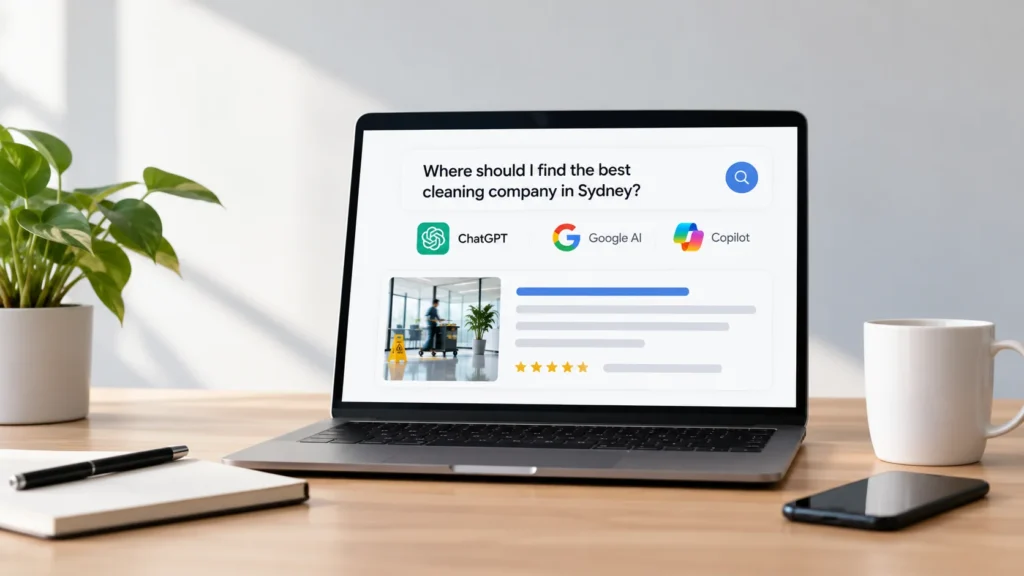
Does Google Business Profile help you appear in ChatGPT?
Possibly indirectly, but there is no primary evidence that Google Business Profile is a direct ChatGPT Search ranking factor.
OpenAI says public websites can appear in ChatGPT Search and recommends allowing OAI-SearchBot so website content can be discovered and cited. OpenAI also says search results are ranked using multiple factors intended to surface relevant and reliable information.
However, OpenAI’s current publisher guidance does not identify Google Business Profile as a direct ranking factor.
This distinction matters because “AI search” is not one system. Google controls Google Search and Google Business Profile. Microsoft has its own local business system, Bing Places. In 2026, Microsoft specifically advised local businesses to keep their Bing Places address, hours and contact information current so those details remain eligible for inclusion in Microsoft AI-generated responses.
That is useful contrary evidence against the idea that one Google profile controls visibility everywhere. Different AI products can use different search providers, indexes, local databases, models and retrieval methods.
For more context on the broader mechanics, see Webbotica’s guide to ranking in ChatGPT and AI search. If you want to see how this fits into the wider service mix, Webbotica also explains its approach to AI search and Google Business Profile management.
The indirect value may still be important
A Business Profile can matter beyond a single ranking signal because it helps establish clear public facts about a business.
Imagine a Sydney electrician whose website says one thing, Google profile says another, opening hours are outdated and service areas are unclear. A search system has more ambiguity to resolve before it can confidently present useful information to a customer.
Now imagine the website and major business profiles consistently explain the business name, services, location or service area, contact details and current hours. That does not guarantee an AI recommendation, but it gives search and retrieval systems cleaner information to work with.
This is an inference rather than a published universal AI-ranking rule. The practical principle is still sound: make important business facts accurate, specific and consistent wherever legitimate customers and search systems encounter them.
What should a local service business optimise in its Google Business Profile?
If the goal is useful visibility rather than chasing AI hacks, start with the parts Google itself tells businesses to maintain.
1. Verify the profile and keep core details accurate
Make sure the business is verified and that its name, phone number, website, address or service-area setup, and opening hours reflect reality. Update special hours when they change.
2. Choose the most accurate business category
Relevance is one of Google’s documented local ranking factors. Your category and business information should describe what the business actually is, rather than trying to squeeze keywords into every field.
3. Make the website and profile agree
If your profile says you provide emergency plumbing in Western Sydney but the linked website never explains that service or where you operate, you are leaving unnecessary ambiguity.
Your service pages should clearly explain what you do, who you help and where the service is genuinely available.
4. Earn genuine customer reviews
Google explicitly says reviews and positive ratings can help local ranking. Reviews also give prospective customers evidence about real experiences with the business.
That is enough reason to build a legitimate review process. There is no need to invent an unsupported claim that a certain number of reviews unlocks ChatGPT or AI recommendations.
5. Use useful, current photos
Google encourages businesses to add photos and videos that show what they offer. For a service business, that can help a person assess the business when they reach the profile. Do it for customers, not because someone promised that uploading a photo every Tuesday is an AI-ranking trick.
6. Keep other important business sources accurate too
Do not stop at Google if customers can find your business elsewhere. Your own website should remain the clearest source of truth you control. For Microsoft’s ecosystem, maintain Bing Places where relevant. Keep legitimate industry and local listings accurate rather than creating hundreds of low-quality directory entries.
What should you not do for “AI optimisation”?
- Do not keyword-stuff your business name. Use the real-world business name and follow Google’s profile policies.
- Do not buy fake reviews. They are deceptive to customers and unnecessary for a legitimate visibility strategy.
- Do not assume frequent Google Posts are a confirmed AI ranking factor. We found no primary evidence establishing that.
- Do not treat GBP as a replacement for your website. AI search can retrieve web pages and supporting sources; your site still needs clear, useful service information.
- Do not assume a strong Google profile automatically transfers to ChatGPT, Copilot or every other assistant. The underlying systems and data sources differ.
How can you tell whether the work is helping?
Measure the channels separately rather than creating one vague “AI visibility” score.
- Use Google Business Profile performance data to understand how people find and interact with the profile.
- Use Search Console to monitor Google Search visibility. Google currently includes traffic from AI features within its overall Web search reporting rather than providing a simple universal GBP-to-AI attribution report.
- Track referral traffic and enquiries from AI assistants where identifiable.
- Check whether important business facts are accurate when your brand is surfaced across major search and AI products.
- Measure actual calls, forms, bookings and qualified enquiries — not just whether an AI mentioned the business once.
AI answers can vary by wording, location, freshness and platform. A single manual prompt is not a reliable ranking report.
So, is Google Business Profile worth prioritising for AI search?
Yes, particularly for a local business — but prioritise it because it is a proven part of Google’s local search ecosystem and because Google itself recommends current Business Profile information for its AI search features.
The evidence becomes weaker when someone claims that GBP directly makes a business rank in ChatGPT or every other AI assistant. OpenAI does not publish such a rule, and Microsoft points local businesses towards its own Bing Places data for Microsoft AI experiences.
The practical strategy is therefore broader than “optimise GBP for AI”:
Keep your Google Business Profile accurate. Keep your website useful and crawlable. Keep legitimate business information consistent across the places that matter. Earn real reviews and reputation. Then measure visibility across Google, ChatGPT and other platforms separately.
That work helps customers today even if AI search changes tomorrow.
Primary sources