Google vs ChatGPT: Why Do They Recommend Completely Different Local Businesses?
We searched Google and ChatGPT for the same type of local business and got completely different recommendations. Here's what that tells us about Google rankings, AI search visibility and what businesses should actually focus on.
Written byWebbotica
Published
Reading time16 min
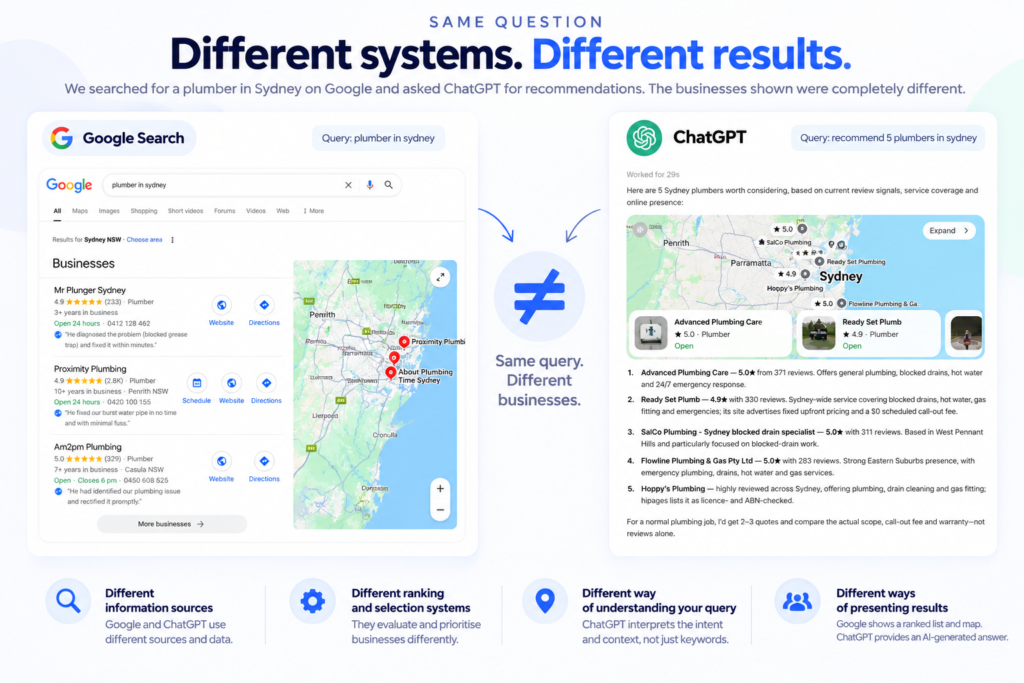
We searched for local businesses in Google and then asked ChatGPT essentially the same question.
The results were completely different.
In our Sydney test, the businesses surfaced by Google were not the same businesses ChatGPT recommended.
That raises an obvious question:
If both Google and ChatGPT have access to information about local businesses, why aren’t they recommending the same ones?
The short answer is that Google local search and ChatGPT are not simply pulling businesses from one shared ranked list.
Google has its own local search systems. ChatGPT can search and synthesise information from the web, use different sources, interpret the wording and context of a question, and produce a generated answer rather than a conventional ranked search results page.
So appearing prominently on Google does not automatically mean you will appear in ChatGPT — and being recommended by ChatGPT does not necessarily mean you rank at the top of Google.
Our test is only one example, so it cannot tell us exactly how either platform selected each business. But when we combine the observation with what Google and OpenAI publicly disclose — and with larger independent studies — the difference becomes much easier to understand.
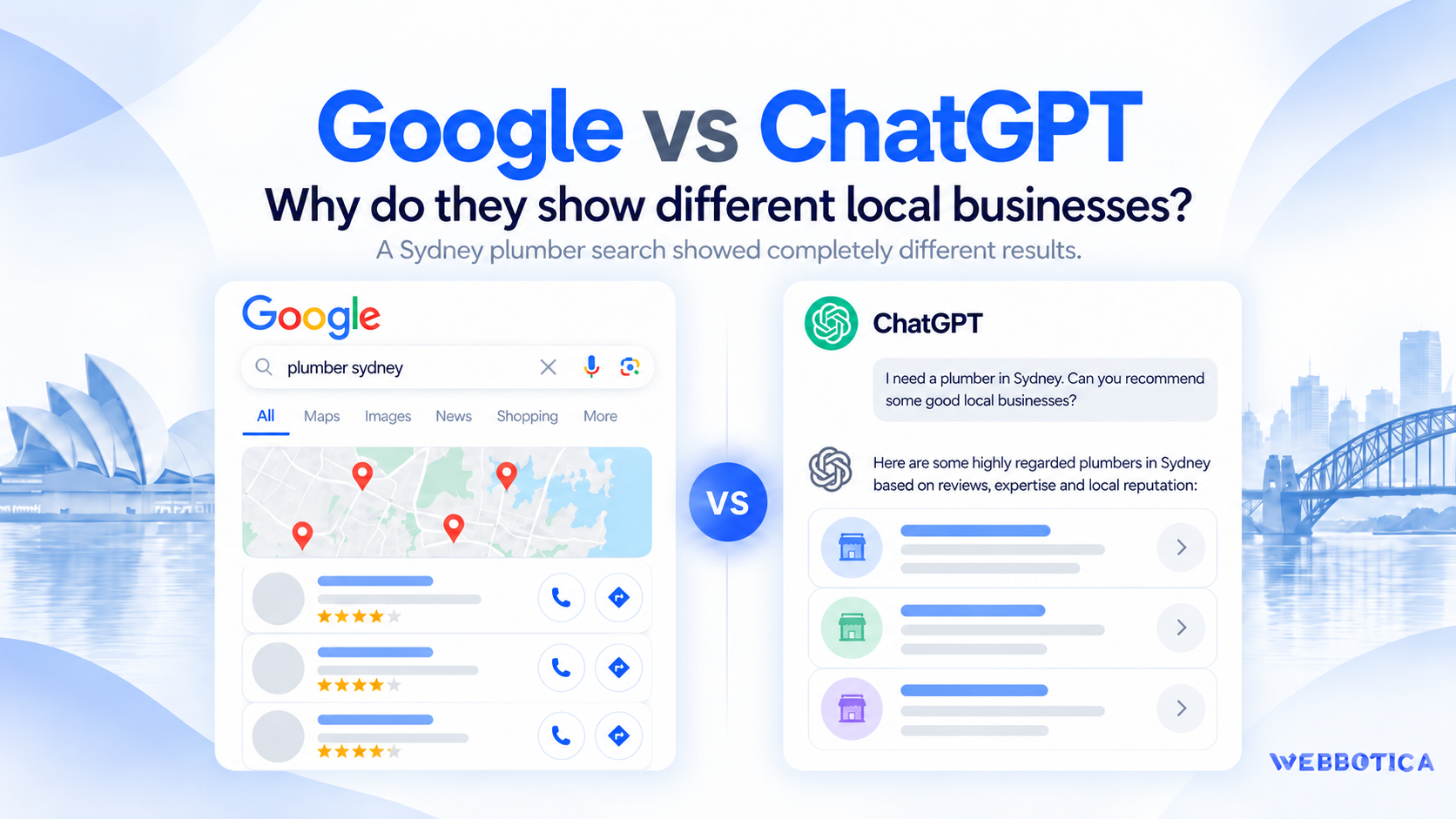
We searched the same thing. The businesses weren’t the same.
Our test was deliberately simple.
We were looking for reliable plumbers in Sydney.
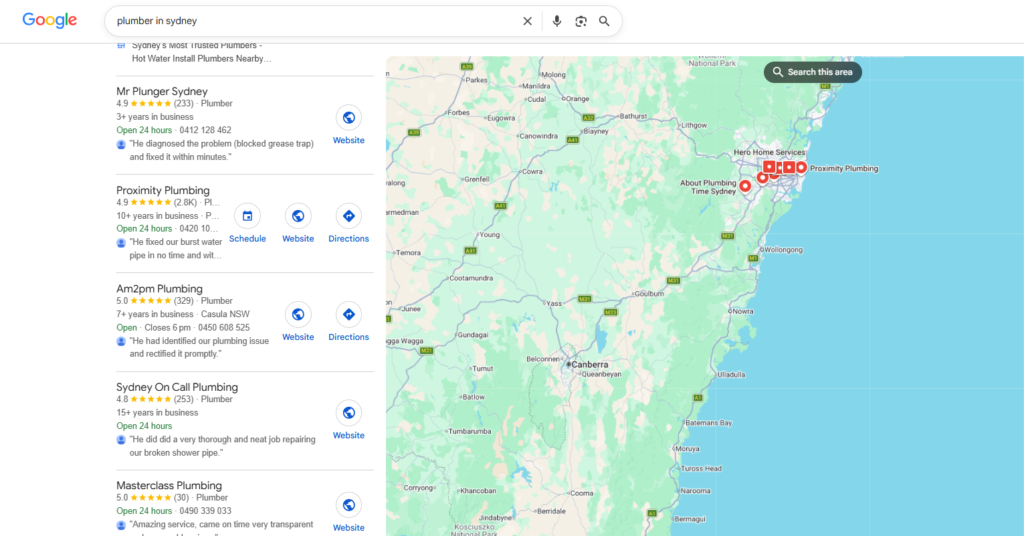
First, we searched using Google.
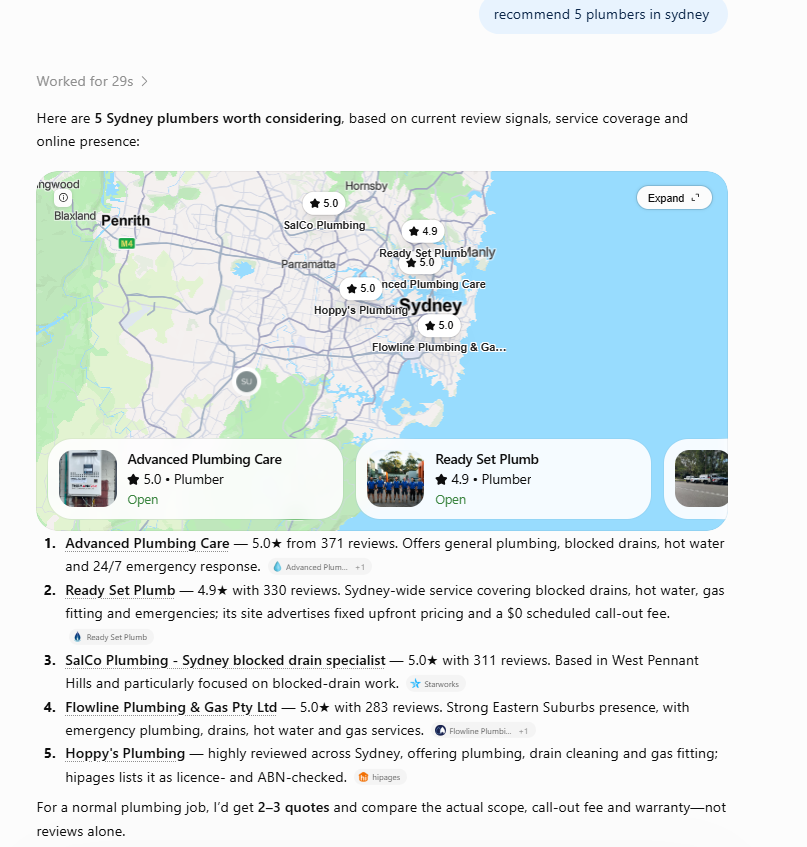
Then we asked ChatGPT for recommendations around the same requirement.
The intention wasn’t to conduct a controlled scientific study. We simply wanted to see what an ordinary customer could experience when looking for the same type of business through two different discovery platforms.
And the result was interesting:
the businesses presented to us were completely different.
Put those screenshots side by side and the difference becomes immediately obvious.
But we need to be careful about the conclusion.
This does not prove that ChatGPT ignores Google.
It does not prove that one platform has better recommendations.
And it does not reveal a secret ChatGPT ranking factor.
What it demonstrates is much narrower:
For the query we tested, Google and ChatGPT produced substantially different sets of local businesses.
Larger datasets suggest that this kind of difference is not unusual.
A September 2026 BrightLocal study analysed more than 200,000 local prompts across ChatGPT, Google’s AI Mode and AI Overviews. It found substantial variation between AI recommendations and traditional Google Maps visibility, as well as variation when identical AI searches were repeated.
So what could be causing it?
First, Google and ChatGPT are solving the problem differently
Google Search traditionally gives you a collection of results to choose from.
ChatGPT is designed to construct an answer.
That difference matters.
When someone searches:
plumber Sydney
Google has to decide which search results, local listings, map results and other features are most useful for that query.
When someone asks:
Can you recommend five reliable plumbers in Sydney?
ChatGPT has to interpret several things:
What counts as reliable?
Does the person want five businesses specifically?
Is location important?
Should reviews be considered?
Should it search the web?
Which sources should it use?
What evidence is strong enough to support a recommendation?
The user may ultimately want the same thing — a plumber — but the systems are being asked to produce different kinds of outputs.
How does Google choose local businesses?
Google is unusually clear about the broad factors behind its local search results.
According to Google, local results are mainly based on:
relevance, distance and prominence.
Relevance
How closely does the business match what the person is looking for?
If someone searches for an emergency plumber, Google needs to understand whether a business actually provides emergency plumbing.
That is one reason complete and accurate Google Business Profile information matters.
Distance
Where is the business relative to the person searching?
Even two people making the same search from different Sydney suburbs may see different local businesses.
Google explicitly says that location can influence search results.
Prominence
How established or well known does the business appear to be?
Google says information such as links, reviews and ratings can contribute to prominence, and that more reviews and positive ratings can help local ranking.
Google’s business information is also assembled from more than the information a business owner enters manually.
Google says Business Profiles can incorporate information from official websites, licensed third-party data, users, business owners and other sources.
So even Google’s local results are already built from a fairly broad information ecosystem.
How does ChatGPT find local businesses?
This is where things become less straightforward.
There is no publicly documented formula saying:
reviews = X%, website = Y%, directories = Z%.
And anyone claiming to know the exact formula should be treated cautiously.
What OpenAI does publicly explain is that ChatGPT Search can retrieve current information from the web and provide sources alongside its answers. OpenAI has also said ChatGPT Search uses third-party search providers as well as content from partners.
For local queries, location can also affect the result.
OpenAI’s current documentation states that users can provide a city, neighbourhood or postcode to improve local results, and that location information may be used to provide more relevant nearby information.
That means a ChatGPT recommendation can potentially be influenced by several layers:
your query → available web information → retrieved sources → location/context → the model’s interpretation → generated answer
That is fundamentally different from assuming ChatGPT simply asks:
“Who ranks first on Google?”
Does ChatGPT just use Google’s local rankings?
There is currently no good public evidence that ChatGPT simply copies Google’s local ranking order.
OpenAI describes ChatGPT Search as using web search and third-party search providers to assemble answers, while Google’s local results are generated by Google’s own local search systems.
Independent research also suggests there is no simple one-to-one relationship.
BrightLocal’s 2026 study found that a tracked business was mentioned in Google Maps searches substantially more often than across the AI surfaces it tested. The study concluded that strong Google Maps visibility did not automatically translate into the same level of AI visibility.
Another 2026 dataset comparing AI recommendations across local markets also found significant disagreement between AI systems themselves.
That doesn’t mean Google performance is irrelevant.
A strong Google presence often results from things such as:
a well-established website,
clear business information,
customer reviews,
third-party mentions,
local relevance,
and strong overall online reputation.
Those same pieces of public evidence may also help other systems understand a business.
But this is very different from saying:
“Rank #1 on Google and you will rank #1 in ChatGPT.”
There is currently no evidence supporting that promise.
AI recommendations can also change between searches
This may be one of the biggest differences business owners need to understand.
Search rankings change, but AI-generated recommendations can be particularly variable.
In BrightLocal’s 2026 dataset, repeated identical local prompts showed relatively low average overlap between result sets. For ChatGPT specifically, the reported average overlap between repeated recommendation sets was about 23%.
That means checking ChatGPT once and seeing your company — or not seeing it — tells you very little by itself.
The answer can potentially change because of:
different source retrieval,
location,
query wording,
context from the conversation,
changes to available web information,
and the non-deterministic nature of generated answers.
Your website still matters
Seeing different results does not mean traditional SEO or your website suddenly stopped mattering.
Quite the opposite.
OpenAI says any public website can potentially appear in ChatGPT Search. It specifically advises website owners who want their content surfaced and cited in ChatGPT Search not to block OAI-SearchBot.
Recent local-AI research also repeatedly shows business websites appearing as important sources.
For example, BrightLocal’s September 2026 analysis of 1.9 million AI citations found that business websites represented a significant portion of the citations used by the AI platforms it tested.
That doesn’t mean having a website guarantees a recommendation.
It means your website is one of the main places where machines and people can understand:
who you are,
what you do,
where you operate,
what services you provide,
why someone might trust you,
and how your business relates to a particular question.
A five-page brochure website containing almost no useful information gives any discovery system far less to work with than a clearly structured, informative website.
Make your business easy to understand
Think about this from the perspective of a search system.
Imagine a Sydney plumbing company whose website only says:
Quality plumbing solutions you can trust.
That sounds fine to a person.
But it tells us very little.
Compare it with a site that clearly explains:
the company operates in Western Sydney,
emergency plumbing is available 24/7,
blocked drains are a core service,
hot-water repairs are available,
which suburbs are serviced,
how emergency call-outs work,
licence information,
years of experience,
common price considerations,
and how customers can contact the company.
The second website gives search systems far more explicit information about the business.
This is useful for traditional search.
It is also useful anywhere an AI system needs to understand whether that business is relevant to a specific question.
Your business exists beyond your own website
There is another important part of AI visibility that businesses can easily overlook.
Your website is not the only source describing your company.
There may also be information about you on:
Google Business Profile,
review platforms,
industry directories,
trade associations,
social profiles,
local publications,
supplier websites,
business directories,
news articles,
community websites,
and other independent sources.
Google itself confirms that it compiles business information from multiple sources, including crawled websites, third-party data and user contributions.
AI search systems can similarly work with information distributed across the public web.
This is why digital visibility should increasingly be thought about as:
“Can the internet clearly understand and verify this business?”
rather than only:
“Did we put the keyword on our homepage?”
Do reviews help you get recommended by ChatGPT?
Reviews deserve a careful answer.
For Google local search, Google directly says review quantity and positive ratings can help local ranking.
For ChatGPT, we should not make the same claim.
There is currently no official OpenAI documentation stating:
More Google reviews directly increase your ChatGPT ranking.
Reviews can still be valuable because they create publicly available information about a business and influence the human decision once someone discovers you.
They may also appear in sources an AI system accesses.
But that is different from proving that review count is a direct ChatGPT ranking factor.
So the practical advice remains straightforward:
earn genuine reviews because customers rely on them and because they strengthen your overall online reputation — not because somebody promised you that 100 reviews unlocks ChatGPT.
Should you create content specifically for AI search?
Yes — but probably not in the way that phrase is normally marketed.
You shouldn’t create hundreds of low-value pages simply because somebody calls them “GEO pages”.
Instead, create information people genuinely need.
For a plumber, that could include:
How much does an emergency plumber cost in Sydney?
What should I do before a plumber arrives for a burst pipe?
When is a blocked drain an emergency?
Can a plumber repair or replace a hot-water system?
Which Sydney suburbs do you service?
What happens during an emergency call-out?
How do I know whether a plumber is licensed?
These are useful questions regardless of whether the answer is discovered through Google, ChatGPT, Gemini, an AI Overview or directly on the company’s website.
Google’s own guidance for its generative AI search features reinforces this principle. Its current documentation recommends foundational SEO, technically accessible websites, and unique, useful, people-first content rather than chasing supposed “AEO/GEO hacks”.
That is a sensible principle beyond Google as well.
What should a local business actually do?
If your business appears strongly on Google but rarely appears in AI recommendations, don’t rebuild your entire marketing strategy around AI.
Start with the fundamentals and expand from there.
Google specifically recommends accurate and complete business information for local visibility.
2. Make your website clearly explain your business
Someone — or something — should not need to guess what you do.
Make your key information explicit:
Who are you?
Where do you operate?
What services do you provide?
Who do you provide them for?
What makes the business legitimate?
How can someone contact you?
Where appropriate, use LocalBusiness structured data to communicate factual business information such as business type, address and opening information in a machine-readable format. Google documents support for LocalBusiness structured data.
Structured data is not a magic AI-ranking switch.
It simply helps make information easier for machines to interpret.
Don’t create articles just because a keyword tool gave you a list.
Publish material based on real customer questions and your actual expertise.
Google’s people-first content guidance explicitly encourages original information, research, analysis and first-hand experience rather than simply rewriting what already exists online.
This article is an example of that principle.
Instead of writing:
10 Ways to Rank Your Business in ChatGPT
and pretending we know a secret formula, we ran an experiment, documented what happened, researched what the platforms actually disclose, and separated evidence from assumptions.
That creates something genuinely new.
4. Build a trustworthy presence outside your website
You should not manufacture mentions or spam directories.
But legitimate third-party references help establish that the business actually exists and is recognised beyond its own marketing.
Depending on the business, that might include:
relevant industry directories,
professional associations,
reputable review platforms,
local publications,
supplier or partner pages,
community organisations,
or genuine editorial coverage.
Focus on places that would make sense even if AI search did not exist.
Continue requesting genuine reviews and responding to customers rather than trying to manipulate ratings.
What you should avoid is turning this into:
“We need another 40 reviews because ChatGPT ranks businesses with 100 reviews.”
We do not currently have evidence for that rule.
7. Track Google and AI visibility separately
This may be the biggest practical change.
Traditionally, a local business might monitor:
Google rankings,
Google Business Profile visibility,
website traffic,
leads,
and conversions.
Now you can add another measurement:
AI visibility.
But don’t run one ChatGPT query once a month and treat it as a ranking report.
Test several realistic customer questions.
For example:
reliable plumber in Sydney
emergency plumber near me
plumber for blocked drains in Western Sydney
who should I call for a burst pipe in Sydney?
recommended plumber open now
good plumber for hot-water repair
Run the searches more than once.
Record:
whether you appeared,
which competitors appeared,
which sources were cited,
which pages were cited,
and whether those patterns change over time.
You are looking for patterns, not obsessing over one answer.
If competitors appear in ChatGPT and you don’t, inspect the evidence
This is where AI-search analysis becomes genuinely useful.
Instead of asking:
“How do I rank in ChatGPT?”
ask:
“What information did ChatGPT find when it recommended these businesses?”
Open the citations.
Look at the websites.
Look at the third-party sources.
Compare them with your own online presence.
You might discover that competitors have:
clearer service pages,
stronger location information,
better explanatory content,
stronger independent mentions,
more complete business information,
or pages that answer the specific question much more directly.
That gives you something concrete to improve.
Don’t optimise for a machine at the expense of the customer
There is going to be an enormous amount of advice around:
AI SEO.
GEO.
AEO.
LLM optimisation.
Some of it will be useful.
Some of it will simply rename good SEO and good marketing.
And some will claim certainty that doesn’t exist.
The safer approach is surprisingly boring:
Create a technically accessible website.
Clearly explain your business.
Build a legitimate reputation.
Publish useful information based on real expertise.
Maintain accurate business information.
Earn genuine reviews.
Be present where your customers and industry already exist.
Make important information easy for both humans and machines to understand.
Then measure how you appear across different discovery platforms.
That doesn’t guarantee a ChatGPT recommendation.
There is currently no honest way to offer that guarantee.
But it creates a stronger digital presence regardless of whether the customer starts their search on Google, ChatGPT, another AI platform, or somewhere else entirely.
The bigger lesson from our Google vs ChatGPT test
The most interesting thing about our experiment wasn’t that ChatGPT recommended different plumbers.
It was what that difference represents.
For years, local digital visibility largely meant:
Can people find us on Google?
That question still matters enormously.
But it is no longer the only question.
Customers can now discover businesses through Google Search, Maps, social platforms, ChatGPT and other AI-assisted experiences.
And those systems don’t necessarily surface the same businesses.
Our simple Sydney test demonstrated that clearly.
Larger studies are beginning to show the same pattern at scale.
So the goal should not be to abandon traditional SEO and chase a mysterious ChatGPT algorithm.
The better question is:
Does the web contain enough clear, credible and useful information for both people and different discovery systems to understand why our business is relevant?
Get that right first.
Everything else is optimisation.
Frequently Asked Questions
Why does ChatGPT show different businesses from Google?
Google and ChatGPT use different systems to produce results. Google local search primarily evaluates signals including relevance, distance and prominence, while ChatGPT can retrieve and synthesise information from multiple web sources before generating an answer. There is no public evidence that ChatGPT simply reproduces Google’s local ranking order.
Does ranking first on Google mean I’ll appear in ChatGPT?
No guarantee exists. Strong Google visibility may indicate that your business has good underlying digital signals, but independent research has found substantial differences between Google Maps visibility and AI recommendations.
Can a business appear in ChatGPT even if it doesn’t rank first on Google?
Yes. AI-generated recommendation sets do not necessarily follow Google’s local ranking order, and the businesses returned can vary between platforms and between repeated prompts.
Does ChatGPT search the internet for local businesses?
ChatGPT can use web search when current information is needed. OpenAI says ChatGPT Search retrieves web information and provides citations, and local information can be affected by location context.
Can I optimise my website for ChatGPT?
You can improve the likelihood that your business information is accessible and understandable, but there is no guaranteed ChatGPT ranking formula. OpenAI recommends allowing OAI-SearchBot if you want eligible public content to be discoverable and cited in ChatGPT Search.
Should businesses focus on Google SEO or AI search?
For most local businesses, strong SEO fundamentals should remain the foundation. A clear website, accurate local information, good technical accessibility, useful content, genuine reviews and a credible online presence support customers regardless of which discovery platform they use.
Sources & Further Reading
Google Business Profile Help — Tips to improve your local ranking on Google Google’s official explanation of relevance, distance and prominence in local search.
Google Business Profile Help — Understand how Google sources and uses information in Business Profiles and local results Explains the different sources Google uses to build business information.
Google Search Central — Creating Helpful, Reliable, People-First Content Google’s guidance on creating original, useful and trustworthy content rather than search-engine-first content.
Google Search Central — Guide to Optimising for Generative AI Features Current Google guidance covering foundational SEO, useful content and generative search experiences.
Google Search Central — LocalBusiness Structured Data Official documentation for communicating local-business information through structured data.
OpenAI — Introducing ChatGPT Search OpenAI’s explanation of ChatGPT Search, web sources and third-party search providers.
OpenAI Academy — Research with ChatGPT Current explanation of how ChatGPT Search retrieves current web information and uses citations.
OpenAI — Publishers and Developers FAQ Official guidance on website discoverability and OAI-SearchBot.
OpenAI Help — Searching the Web with ChatGPT Information about location and local results in ChatGPT Search.
BrightLocal — Local AI Visibility Study, September 2026 Independent commercial research analysing more than 200,000 local AI prompts and 1.9 million citations. Its findings are useful supporting evidence, but should be interpreted in the context of its methodology rather than treated as documentation of any platform’s algorithm.
READY FOR THE NEXT STEP?
Put the advice into practice.
If you want help improving how your business is found, trusted and contacted online, we can work out the right next step with you.